
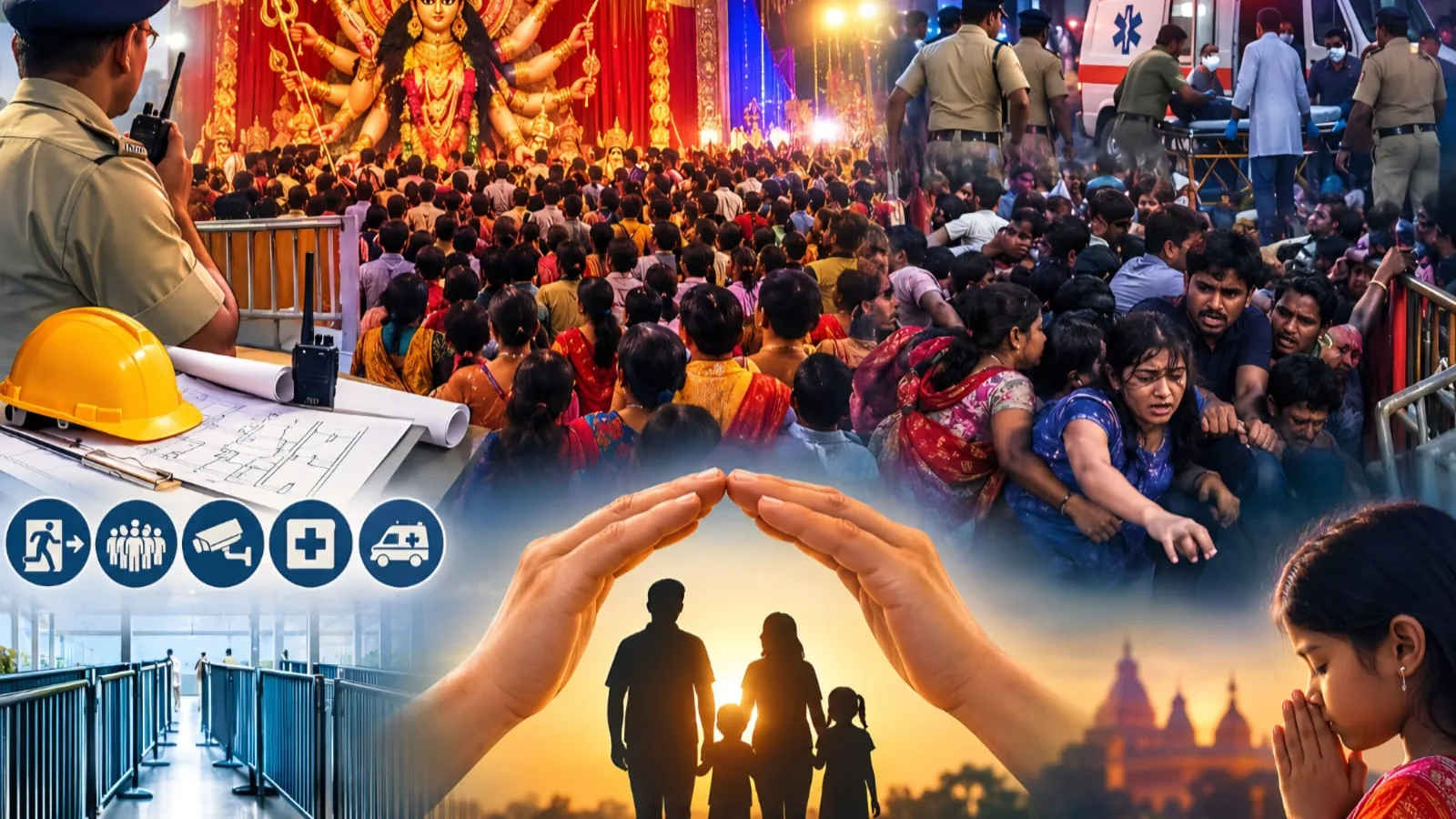
The news of the stampede at the public Durga Puja pandal in Chorbagan, Kolkata, during the Durga Puja celebrations, which reportedly claimed 19 lives and left more than 25 people injured, has shocked the entire nation. This was not merely an accident; it has raised serious questions about our collective insensitivity, administrative negligence and irresponsible approach towards religious gatherings. When people visit pandals in search of faith, devotion, joy and spiritual peace, what greater irony could there be than their being denied even the assurance of safety? The worship of Goddess Durga symbolises strength, courage and the destruction of evil. Yet, when innocent lives are lost in the very midst of such worship, we are compelled to reflect seriously on our arrangements, our priorities and our sense of responsibility. How long will human lives continue to be swept away in this tidal wave of faith? The most important question is not merely how such tragedies occur, but why they are allowed to happen in the first place.
Stampedes at religious fairs, temples, pilgrimage sites, festivals and political rallies have repeatedly made headlines across the country. Each time, the lights go out in the homes of grieving families; children lose the protective presence of their parents, mothers are left with empty arms, and spouses see their entire world collapse. For a while, news reports are dominated by mourning, condolences, compensation announcements and inquiries. Gradually, however, everything returns to normal. Systems remain unchanged, and the stage is set for the next tragedy. Has the sensitivity of our administrative machinery been reduced to waking up only after a disaster? Can the value of a human life ever be adequately compensated through financial assistance or government announcements? When will we awaken to these tragic and deeply disturbing incidents that tarnish the splendour and dignity of our glorious Sanatan cultural heritage?
Providing financial assistance to the families of those killed in an accident is essential. In times of crisis, government support can offer some relief and reassurance to the affected families. But compensation cannot bring back a lost life. A family's financial losses may perhaps be mitigated with money, but who can put a price on the tears of a mother who has lost her young son? Who can fill the emptiness and heal the fear of a child who has lost both parents forever in a crowd? The responsibility of governments, therefore, cannot be limited to announcing relief packages. Their foremost duty is to prevent the circumstances that put citizens' lives at risk. Providing compensation after a death is a humane obligation of the state; ensuring safety before a death occurs is its indispensable responsibility. An unhealthy competition for grandeur and popularity is also becoming increasingly evident in religious celebrations. Massive pandals, elaborate decorations, magnificent idols, dazzling lights, publicity and the gathering of ever-larger crowds are often treated as the benchmarks of a successful event. But should the success of a religious celebration be measured merely by the size of the crowd it attracts? Should organisers and committees not understand that the greater the number of devotees, the greater their responsibility for ensuring their safety? Allowing thousands of people to enter through narrow lanes, with limited exits, obstructed passageways and inadequate safety arrangements, is not a sign of a successful celebration. It is an invitation to potential disaster.
The Kolkata tragedy has once again demonstrated that crowd management is not a mere formality; it is an essential measure for protecting human life. Before any major religious gathering, the venue's capacity must be assessed scientifically. Entry and exit routes should be separate, sufficiently wide and unobstructed. Emergency exits must be clearly marked, the movement of crowds should be regulated in a controlled direction, and an adequate number of trained personnel must be deployed. CCTV surveillance, public announcement systems, medical assistance, ambulances and fire services should be readily available. Rain, power failures, sudden rumours or an unexpected announcement can alter crowd behaviour within moments. Every event must, therefore, have a well-defined emergency response plan, regular safety drills and arrangements for an immediate response to any crisis. Safety preparations must begin at the planning stage, not after a tragedy has occurred. The administration's role is particularly crucial in this entire scenario. The police and local authorities must not confine themselves to issuing permissions or conducting routine inspections during an event. Before granting approval, they must inspect the venue, assess the anticipated crowd size, verify compliance with safety standards and ensure the availability of adequate exit routes. Entry must be stopped immediately if the prescribed capacity is exceeded. Organisers who violate safety regulations must face strict action, and if an inquiry establishes negligence on the part of officials, their accountability must also be fixed. The influence of a committee, the prestige of an organiser or the popularity of a festival cannot be allowed to supersede the law or the safety of citizens. Without accountability, safety measures remain little more than declarations on paper.
At the same time, it would be unfair to assume that every stampede is caused solely by administrative failure. Rumours, pushing and shoving, the sudden urge to move forward, and attempts to escape without considering the safety of others can also turn an already difficult situation into a catastrophe. Ordinary citizens, therefore, have an important responsibility as well. They must remain calm at religious venues, follow designated routes, refrain from pushing, take special care of children and elderly people, and pay attention to official instructions. If a crowd becomes dangerously dense, they should avoid insisting on moving forward, seek a safer position where possible and follow the directions of trained personnel. Organisers should also raise awareness among devotees that devotion does not mean disorder; it calls for discipline and respect for the lives of others. The fundamental message of our religion and culture rests on compassion, non-violence, service and reverence for life. Worship becomes truly meaningful only when our faith serves as a means of protecting humanity. If safety is neglected at a religious gathering, it is not merely an administrative lapse; it is also a departure from the very values that the celebration claims to uphold. A society that worships the Goddess must also ensure that no devotee loses their life because of disorder and mismanagement. Faith does not mean closing one's eyes and becoming an unthinking part of a crowd. It means practising one's religion with wisdom, restraint and a sense of responsibility.
The time has now come to ensure that every such tragedy leads to an independent inquiry, clear accountability and concrete corrective measures. Investigation reports should be made public, action against those found responsible should be taken within a stipulated time frame, and safety standards for future events should be reviewed regularly. The central and state governments must develop uniform minimum safety standards for major religious gatherings. Effective coordination among organising committees, the administration, police, healthcare services and volunteers must be made mandatory. Compliance with these arrangements must be visible on the ground, not merely documented in official files. The Kolkata tragedy is a warning that negligence hidden behind the glitter of celebration can descend into darkness at any moment. The true tribute to those who lost their lives is not limited to expressing grief or providing assistance to their families. It lies in resolving that such accidents must never be allowed to happen again. Governments must awaken, the administration must recognise its responsibilities, organisers must place public safety above personal prestige, and citizens must allow wisdom to guide their faith. How many more tragedies will it take for us to learn? How many more families must be shattered before our systems change? And how many more lives must be sacrificed before we understand that no festival, no gathering and no religious belief can ever be greater than human life itself? Faith will be truly honoured only when every devotee can enter a celebration safely and return home unharmed.
.