
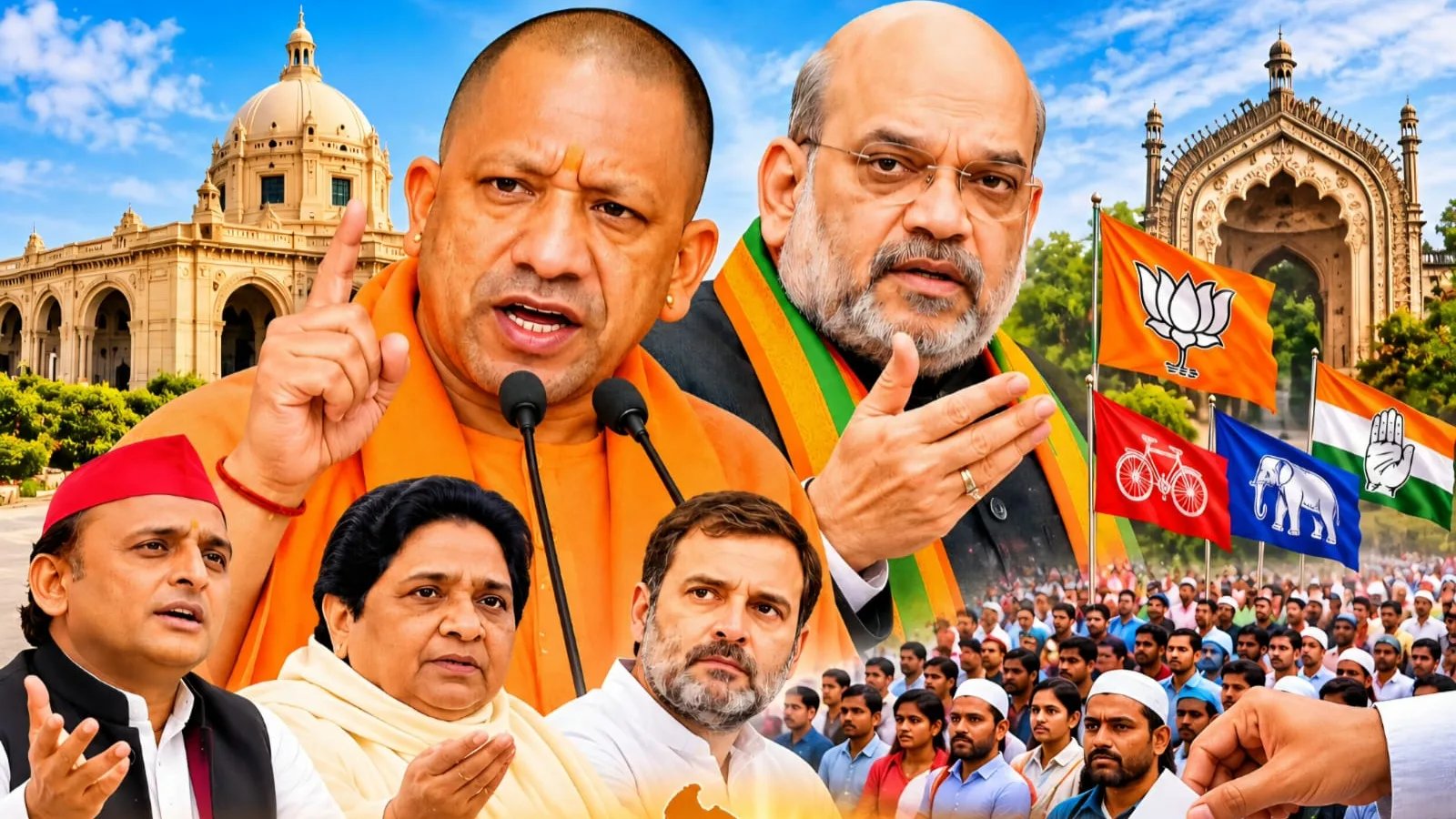
The 2027 Assembly elections in Uttar Pradesh may still be several months away, but the political chessboard is already taking shape. With 403 Assembly seats, Uttar Pradesh is not merely another state heading for an election; it is a decisive political battleground capable of influencing the direction of national politics. This is why the political landscape is being closely watched—from Chief Minister Yogi Adityanath’s growing political activity and organisational changes within the Bharatiya Janata Party (BJP), to Akhilesh Yadav’s political strategy, the possible alliances among opposition parties, and the emerging equations surrounding Muslim voters. The central question is whether the opposition can mount a credible challenge to Yogi’s strong political standing, and whether changing preferences among Hindu voters, beyond the consolidation of Muslim votes, will ultimately prove decisive. Another important question is whether Prime Minister Narendra Modi’s leadership, personal appeal and welfare initiatives will once again play a significant role in shaping the political fortunes of the state.
To begin with, the BJP’s greatest strength lies in Yogi Adityanath’s leadership and the achievements claimed by his government. Law and order, infrastructure development, expressways, the development of religious and cultural centres, and the implementation of welfare schemes jointly undertaken by the Centre and the state are likely to form the core of the party’s electoral narrative. Yogi has asserted that the 2027 contest will be fought on the lines of ‘80 versus 20’ and that the BJP-led alliance will secure more than 300 seats. However, electoral claims and the actual mood of the electorate do not always move in the same direction. The BJP’s challenge, therefore, is not merely to highlight its achievements but also to ensure that anti-incumbency sentiments do not erode its traditional social support base.
An important aspect of the BJP’s strategy this time is its attempt to reach out to sections of the Muslim community. In August 2026, two Muslim leaders from Uttar Pradesh were given significant responsibilities in the party’s national organisation. Former Aligarh Muslim University Vice-Chancellor Prof. Tariq Mansoor was appointed National Vice-President, while Kunwar Basit Ali was entrusted with the responsibility of heading the BJP’s National Minority Morcha. Political observers have interpreted these appointments as part of the BJP’s broader strategy to expand its reach among Pasmanda Muslims and certain other sections of the Muslim community ahead of the 2027 elections. This move assumes significance because, according to the 2011 Census, Muslims constituted 19.26 per cent of Uttar Pradesh’s population. Their electoral influence can be decisive in several constituencies, particularly in western Uttar Pradesh and certain other regions. However, the BJP’s challenge is that while making inroads into Muslim votes may be difficult, retaining the unity of its traditional Hindu support base could prove an equally, if not more, demanding task.
This brings us to the second, and perhaps more significant, dimension of the electoral contest. While considerable attention is being paid to the consolidation of Muslim votes, it is equally important to understand the changing priorities and political preferences of Hindu voters. The electorate does not vote exclusively on the basis of caste and religion. Employment opportunities, inflation, farmers’ concerns, education, prospects for the youth, the public image of local legislators, administrative conduct and the actual reach of development initiatives also influence voting behaviour. Therefore, it may not be sufficient to understand the 2027 election merely through the political narrative of ‘80 versus 20’.
This is precisely where the Samajwadi Party sees its greatest opportunity. Akhilesh Yadav will seek to consolidate the social coalition that emerged in his party’s favour during the 2024 Lok Sabha elections and translate it into electoral strength at the Assembly level. The PDA formula—Pichhda, Dalit and Alpsankhyak (Backward Classes, Dalits and Minorities)—is intended to make inroads into the BJP’s traditional support among non-Yadav OBCs and Dalit voters. The biggest challenge before the Samajwadi Party is to ensure that this social coalition does not remain merely an electoral slogan but is transformed into a formidable political force through effective booth-level organisation and judicious candidate selection.
The role of the Bahujan Samaj Party (BSP) cannot be ignored either. It would be politically risky for both the BJP and the Samajwadi Party to underestimate Mayawati’s potential to influence the outcome. If she succeeds in reactivating her traditional Dalit support base, a triangular contest in several constituencies could alter the electoral outcome. The Congress, though relatively weaker in the state, could help prevent the fragmentation of opposition votes if it enters into an electoral understanding with the Samajwadi Party. However, lessons from past political experiences appear to have made the Samajwadi Party cautious about entering into an alliance with the Congress without carefully assessing its electoral implications.
Another major challenge before the BJP will be to maintain a balance within its alliance and among its diverse social constituencies. The expectations of its allies, including the Nishad Party, the Suheldev Bharatiya Samaj Party (SBSP) and other regional partners, along with issues relating to ticket distribution and the political ambitions of regional leaders, could become crucial as the elections approach. The BJP’s strong organisational machinery may help contain these differences, but even a minor miscalculation in candidate selection could cause considerable electoral damage in certain regions.
The growing involvement of Union Home Minister Amit Shah also underscores the importance the BJP attaches to Uttar Pradesh. The party’s electoral strategy is unlikely to be shaped by Lucknow alone; it will probably be formulated under the close supervision of the central leadership in New Delhi. At the same time, Yogi Adityanath’s personal popularity and administrative image remain the BJP’s strongest assets in the state. The real challenge, therefore, will be to ensure that Yogi’s leadership and the central organisation’s electoral strategy complement each other effectively and work in complete coordination.
The most significant question in this election will be whether the people of Uttar Pradesh choose stability and continuity or express a desire for political change. The BJP has the advantages of organisational strength, incumbency, Yogi Adityanath’s leadership and an extensive electoral machinery. The opposition, on the other hand, can draw strength from anti-incumbency sentiments, the issue of social justice and the possibility of bringing together different sections of society opposed to the BJP. In such circumstances, declaring any one party the certain winner at this stage would be premature. The BJP’s target of crossing the 300-seat mark will not be easy to achieve, but it would be equally unwise for the opposition to underestimate its strength. The Samajwadi Party has a significant opportunity, but converting that opportunity into electoral victory will require organisational consolidation alongside its social coalition. The BSP and the Congress, too, could emerge as potential game-changers in several constituencies.
For Yogi Adityanath, the 2027 election will not merely be a test of his ability to counter the shifting political equations among opposition parties, the consolidation of Muslim votes and the growing influence of the Samajwadi Party. Equally important will be his ability to maintain internal cohesion and balance within the BJP itself. In this context, Home Minister Amit Shah’s active involvement in shaping the party’s Uttar Pradesh strategy could prove to be a significant source of support for Yogi. The cornerstone of Shah’s electoral approach has traditionally been the expansion of social coalitions, strengthening of the organisation at the booth level and effective coordination among alliance partners. If this strategy is harmonised with Yogi’s administrative image and popular appeal, the BJP could effectively counter the opposition’s challenge.
However, any visible imbalance in strategic priorities between the central leadership and the state leadership could provide the opposition with a political advantage. The BJP’s greatest requirement is to project Yogi Adityanath as its undisputed electoral face while ensuring that Amit Shah’s organisational strategy serves as a complement to his leadership rather than being perceived as a competing power centre. The political strength of Yogi in 2027 will thus depend not only on the achievements of his government but also on the balance established between Amit Shah’s electoral strategy and the party’s internal discipline. For this, an atmosphere of mutual understanding, harmony and strategic coordination between Shah and Yogi will be essential.
Ultimately, the 2027 Uttar Pradesh Assembly election will be much more than a contest between Hindus and Muslims, the BJP and the Samajwadi Party, or Yogi Adityanath and Akhilesh Yadav. It will be a test of the electorate’s evolving political judgement, its lived experience of development, the credibility of social representation and its aspirations for the future. The direction in which the electoral tide will turn is still uncertain. What is clear, however, is that the contest in Uttar Pradesh is likely to be more complex, multi-layered and politically engaging than in previous elections. It is precisely this complexity that will make the 2027 Assembly election one of the most consequential electoral battles in Indian politics.