
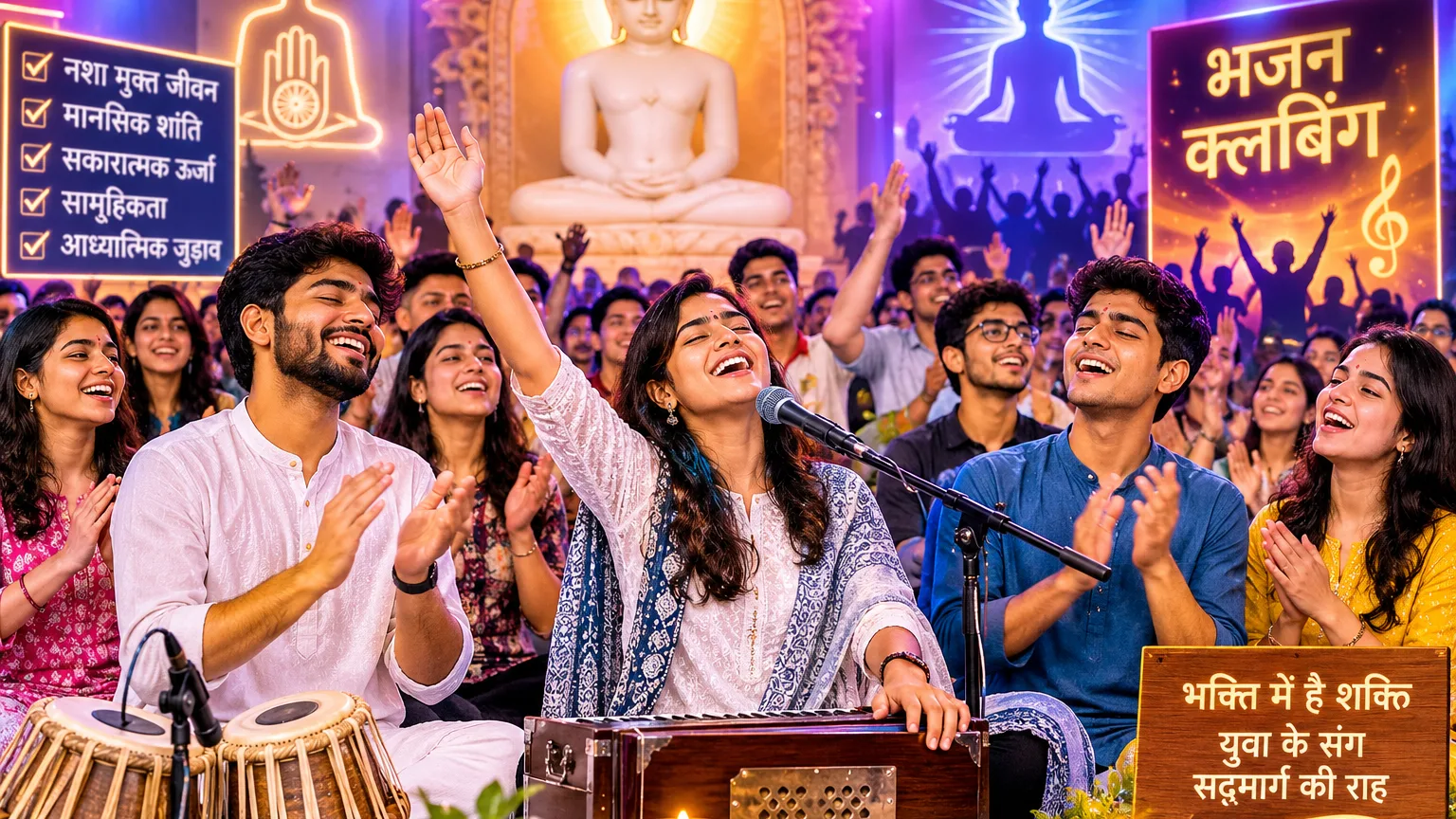
Spirituality is no longer seen merely as something reserved for the twilight years of life. It is increasingly finding a place in the heartbeat of the younger generation. In an age marked by digital frenzy, loneliness, stress, and constant screen exposure, young people are searching for forms of devotion that resonate with the pace of their lives and the way they express themselves. It is against this changing social backdrop that “Bhajan Clubbing” has emerged as an intriguing new cultural trend. Bhajan clubbing essentially means taking devotional songs, bhajans and kirtans beyond the conventional boundaries of religious gatherings and presenting them in an atmosphere where young people sing, sway, dance and immerse themselves in the rhythm of devotion. The ambience may carry the energy of contemporary music, but devotion remains at its core. In a sense, it can be described as a confluence of the energy of a club and the intimacy of a satsang.
This transformation is significant because, for a long time, there has been a widespread perception that religion and spirituality are subjects primarily associated with the older generation. As the younger generation has moved forward with modernity, rational thinking and technology, it has often appeared increasingly distant from traditional religious rituals. Yet the emergence of bhajan clubbing seems to challenge this assumption. Young people are saying that they want spirituality, but its expression can also be aligned with their language, lifestyle and contemporary sensibilities. In India, club culture developed largely as a medium of entertainment, music, dance and social interaction. Late-night gatherings have traditionally been associated with loud music, dazzling lights and a modern lifestyle. The entry of devotion into this very social framework is, therefore, an interesting sign of cultural change. In bhajan clubbing, alcohol, smoking and intoxicants are generally replaced by devotional music, collective singing and positive energy. This distinction is important. If young people are going out at night in search of entertainment, offering them an alternative where joy is accompanied by spiritual connection is certainly worth considering.
Another important dimension is collective togetherness. Social media has connected people virtually, yet real-life loneliness has increased. Despite having thousands of digital friends, a person can often feel profoundly alone. At a bhajan club, even strangers come together and sing in one voice. For a while, the mobile phone recedes into the background and human beings come closer to one another. Such an experience can also provide psychological relief and a sense of belonging. Today’s youth do not merely want to listen to sermons; they want to experience something. They do not accept an idea simply because tradition says so. They want to know: What does this offer me? Bhajan clubbing appears to provide a practical response to that question.
Music has a direct influence on human emotions. Through collective singing, an individual rises above personal boundaries and becomes part of something larger. When hundreds of people simultaneously invoke the names of Rama, Mahavira, Shiva, Krishna or any other revered deity, a powerful collective energy can emerge. From the Jain perspective, however, the fundamental purpose of devotion is not merely external celebration or emotional excitement; it is an inward journey towards the soul. If the Navkar Mantra, devotional hymns, Bhaktamar Stotra, Mangal Path or hymns in praise of the Tirthankaras reach young minds through music, such experimentation can certainly be welcomed—provided that devotion does not dissolve into mere entertainment. This is the greatest test of the entire phenomenon.
In India’s public life too, spiritual and cultural consciousness has become increasingly visible in recent years. Prime Minister Narendra Modi, along with several national leaders and public personalities, has been actively associated with programmes connected with Indian traditions, yoga, meditation, temples, pilgrimage and cultural heritage. This has helped convey to the younger generation that modernity and spirituality are not mutually exclusive. At the same time, it must be understood that the presence of any political or popular personality cannot, by itself, be regarded as the ultimate validation of a spiritual trend. The real strength of any movement lies in its ability to contribute to character-building and social transformation. If bhajan clubbing helps young people stay away from addiction, reduce mental stress, reconnect with their families, develop a spirit of service and cultivate self-discipline, only then will its deeper significance truly be established.
Every emerging popular trend also carries certain risks. The greatest danger is that devotion may gradually turn into nothing more than a fashionable event. If the objective becomes loud music, dazzling lights, dancing and entertainment rather than inner peace, the distinction between bhajan clubbing and conventional club culture may gradually disappear. The second danger is commercialisation. If expensive tickets, sponsorships, branding and a culture of display begin to dominate in the name of devotion, spirituality could itself become a marketable commodity.
The third concern is blind imitation of a particular individual, group or style. Building a community is a positive thing, but if community begins to replace reflection and encourages unquestioning surrender, it can no longer be regarded as healthy spirituality. The fourth issue concerns the intensity of music. Spirituality does not necessarily require soft or slow music, nor is loud music inherently opposed to spirituality. India’s devotional traditions have always had a place for dance, kirtan, celebration and ecstatic expression. However, if the sound becomes so intense that the mind is driven towards overstimulation rather than inwardness, the original purpose may be weakened.
The most important point in this entire debate is that spirituality is a journey beyond external expression. Swaying for two hours at a bhajan club may provide a deeply uplifting experience, but its real value will be determined by what happens in life the following day. The questions that matter are these: Has the young person become more disciplined? Has compassion increased? Has respect for parents grown stronger? Has he or she moved away from intoxicants? Has a spirit of service emerged? Has anger diminished? Has sensitivity towards nature and society increased? If the answers to these questions are yes, bhajan clubbing can become much more than entertainment. It can evolve into a powerful instrument of spiritual and social transformation.
In the coming years, bhajan clubbing may undoubtedly develop in newer forms. Temples, spiritual institutions, universities and youth organisations can create innovative programmes combining music, meditation, yoga, dialogue and service. But one guiding principle must remain clear: “Let the presentation be modern, but never compromise the spiritual values at its core.” It is necessary to make the expression of devotion youthful, but there is no need to make the soul of devotion youthful. That soul is eternal. It is timeless, universal and beyond geographical boundaries. What needs to change is only its language, presentation and accessibility so that it can meaningfully reach the present generation. Bhajan clubbing, therefore, represents both an opportunity and a challenge. The opportunity lies in opening a new door through which modern youth can reconnect with religion and spirituality. The challenge lies in ensuring that this door does not become an entry point for commercialism, superficiality, cultural distortion and excessive entertainment.
Ultimately, the success of bhajan clubbing will not be measured by how many young people danced to the music, but by how many began to look within themselves. If the energy of the club leads to inner peace, if music purifies the mind, and if devotion inspires people to live better lives, then bhajan clubbing will not merely be a new fashion among the younger generation. It will represent a new doorway through which spirituality is entering the modern age. And when devotion moves beyond the stage and begins to manifest itself in everyday conduct, it will truly be possible to say: The music in the club has changed—but far more importantly, the music of life has begun to change.