
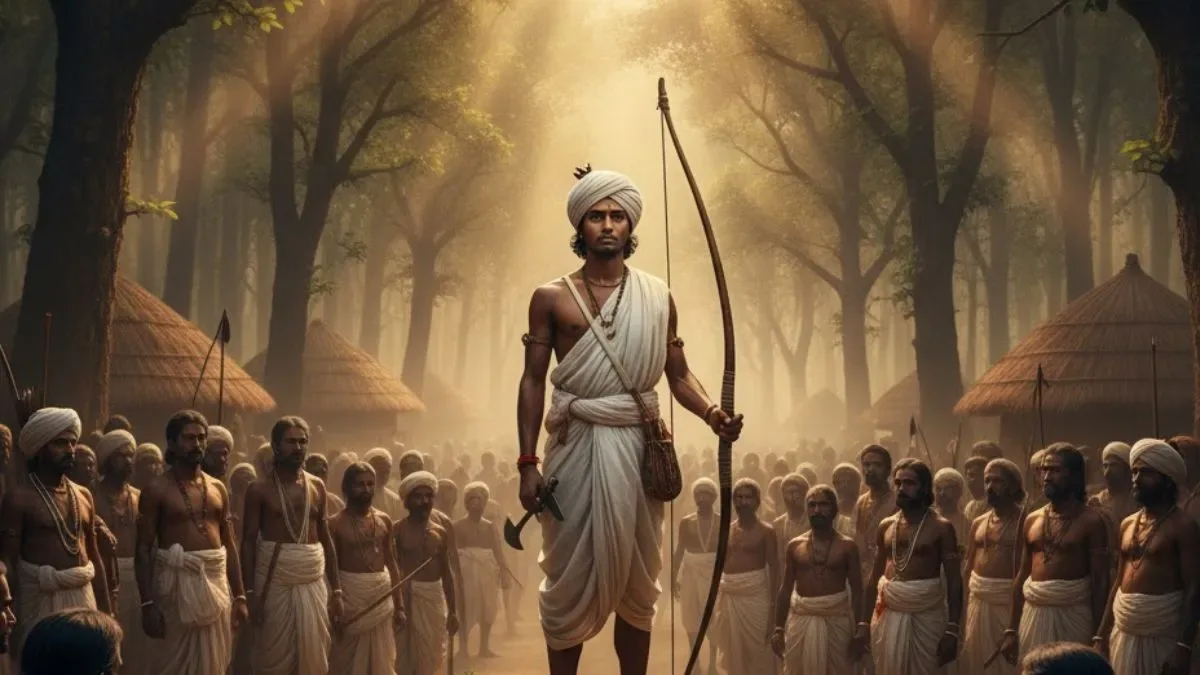
A great personality is not judged merely by the popularity he enjoys in his lifetime, but by how deeply he understands the pain of his people, how fearlessly he stands against injustice, and what kind of consciousness he leaves behind for generations to come. By this measure, Birsa Munda stands among the most remarkable heroes of Indian history. His life was brief, but his struggle was monumental. At barely 25 years of age, he challenged British imperialism, the exploitative zamindari and moneylending systems, social evils and cultural subjugation, awakening a powerful consciousness that elevated him beyond the status of an Adivasi leader and placed him among the foremost popular heroes of India’s freedom struggle. Birsa Munda’s movement represented the assertion of tribal identity, freedom, Jal, Jungle and Zameen—water, forests and land—and spiritual faith. His struggle and his call for freedom through the Ulgulan, meaning the Great Tumult or Great Rebellion, contributed significantly to the awakening of India’s freedom consciousness. He is revered as Dharti Aaba, the Father of the Earth, and Birsa Bhagwan, Birsa the Divine. His struggle was not merely a battle against the British; it was a great crusade for dignity, self-respect, identity and self-rule.
Born on 15 November 1875 in Ulihatu, Jharkhand, Birsa Munda’s life reflected the story of an India that the colonial rulers viewed largely through the prism of revenue and natural resources. For an Adivasi, a forest was not merely a forest, land was not merely land, and a river was not merely a source of water. They were the foundation of his way of life, culture, faith and very existence. When British rule and the zamindari-moneylending system began undermining this way of life, rebellion was born within Birsa. This brings us to a deeper understanding of Birsa Munda’s struggle. His movement was not simply a political campaign to drive the British out of India. It was much broader and more profound. It raised fundamental questions: Whose forests? Whose land? Whose rule? Whose culture? And whose rights? These questions became the very soul of his historic Ulgulan.
Birsa realised that a society can be enslaved not only by an external power but also weakened by its own internal shortcomings. Therefore, before taking up the weapon of resistance, he chose character, reform and consciousness as his first weapons. He raised his voice against superstition, addiction, social evils and regressive practices prevalent in tribal society. He encouraged people to remain conscious of their faith, culture and traditions. He inspired them to stay away from violence and intoxication, lead an ethical life and preserve their collective unity. In this sense, Birsa was not merely a revolutionary; he was also a social reformer who sought to transform society from within. He understood that a society whose self-confidence has been crushed cannot sustain resistance against external exploitation for long. Therefore, he first awakened self-respect within the tribal community and then mobilised it against colonial power.
His struggle was fundamentally about protecting the rights of farmers and tribal communities whose traditional rights had gradually been taken away by the colonial system. Moneylenders offered loans and eventually took control of land. The zamindari system institutionalised exploitation. Colonial laws were alien to the traditional tribal way of life. Birsa challenged this entire structure. For him, Swaraj did not simply mean a change of rulers. Swaraj meant the right to one’s own land, the right to one’s own culture, and the right to determine one’s own destiny. This is precisely why Birsa’s Ulgulan became such an extraordinary chapter in Indian history. Between 1895 and 1900, his influence grew rapidly. The British administration regarded his movement as a serious threat. Arrests, repression and firing followed, but the consciousness he had awakened could not be imprisoned.
The incident at Dombari Hill in January 1900 intensified the conflict. Eventually, Birsa Munda was arrested on 3 February 1900, and he died in Ranchi Jail on 9 June 1900. His death ended his physical existence, but the British failed in their attempt to erase him from history. He continued to live through folk songs, oral traditions, collective memories and the consciousness of tribal communities. That is the true victory of a great leader—when the person departs, but his ideas became part of the collective consciousness of society. And here emerges perhaps the most extraordinary dimension of Birsa Munda’s personality: he did not remain merely a hero of the tribal people; he became a figure of divine reverence— ‘Birsa Bhagwan’. In Jharkhand and adjoining regions, he is revered as Birsa Bhagwan and Dharti Aaba. This is not merely a matter of religious faith. It represents the profound gratitude of a community that saw in Birsa a saviour who fought for its land, culture, dignity and rights. The man who sacrificed his life to protect their identity and existence became a divine figure in their collective imagination.
The role of Prime Minister Narendra Modi in giving Birsa Munda a prominent place in India’s national memory deserves special mention. Prime Minister Modi has presented Birsa not merely as a tribal hero but as a national hero of India’s freedom struggle and national identity. The declaration in 2021 of 15 November as ‘Janjatiya Gaurav Diwas’—Tribal Pride Day—was an important milestone in this national remembrance. The nationwide programmes organised during 2024–25 to commemorate Birsa Munda’s 150th birth anniversary further strengthened this process of remembrance. In 2024, the Prime Minister unveiled a commemorative coin and postage stamp at Jamui in Bihar and launched several initiatives connected with the development of tribal regions. In 2025, on the occasion of Birsa Munda’s 150th birth anniversary, the Prime Minister once again paid national tribute to him at Dediapada in Gujarat, highlighting the pioneering role of tribal communities in protecting India’s freedom, honour and self-respect. The significance of bringing Birsa Munda to the centre of the national discourse goes beyond merely due recognition to a great tribal hero. It has also broadened the way Indian history is understood.
The story of India’s freedom struggle can no longer be viewed merely through the lens of Delhi, Mumbai, Kolkata or other major political centres. It must also include the innumerable struggles that emerged from forests, hills and tribal regions and challenged British power. Various initiatives have also been undertaken to preserve the history and culture of tribal freedom fighters, including the establishment of museums and other institutions dedicated to tribal heritage. Birsa Munda’s relevance becomes even greater today because the question of water, forests and land has once again emerged at the centre of debates on development and the environment. Birsa reminds us that development cannot mean uprooting a community from its cultural and ecological foundations. If tribal communities are to be brought into the mainstream of development, their culture, traditions, community life and traditional relationship with natural resources must also be respected. Development must not become an instrument of displacement; it must become a means of empowerment, dignity and inclusion.
Remembering Birsa Munda today does not merely mean placing flowers before his statue. It means defending the dignity of the deprived, respecting nature, raising our voice against exploitation and ensuring that those heroes who were pushed to the margins of history receive their rightful place in the national narrative. The life of Birsa Munda also teaches us that great revolutions do not always emerge from magnificent palaces or centres of power. Sometimes they rise from the narrow trails of forests, take shape in the voice of an ordinary young man, and eventually shake the foundations of an empire.
Birsa Munda’s life may have been short, but his struggle became immortal. His body perished within the walls of a prison, but his idea remains free. He became Birsa Bhagwan for the tribal community because he awakened within them a power that was almost divine—the power of self-respect, dignity and freedom. Therefore, the true tribute to Birsa Munda lies not merely in remembering him as a character from the pages of history, but in understanding him as a guardian of justice, dignity, nature and human freedom. The call of Dharti Aaba still resonates today:Stay rooted in your heritage. Recognise your rights. Stand with dignity. And never bow before injustice.