
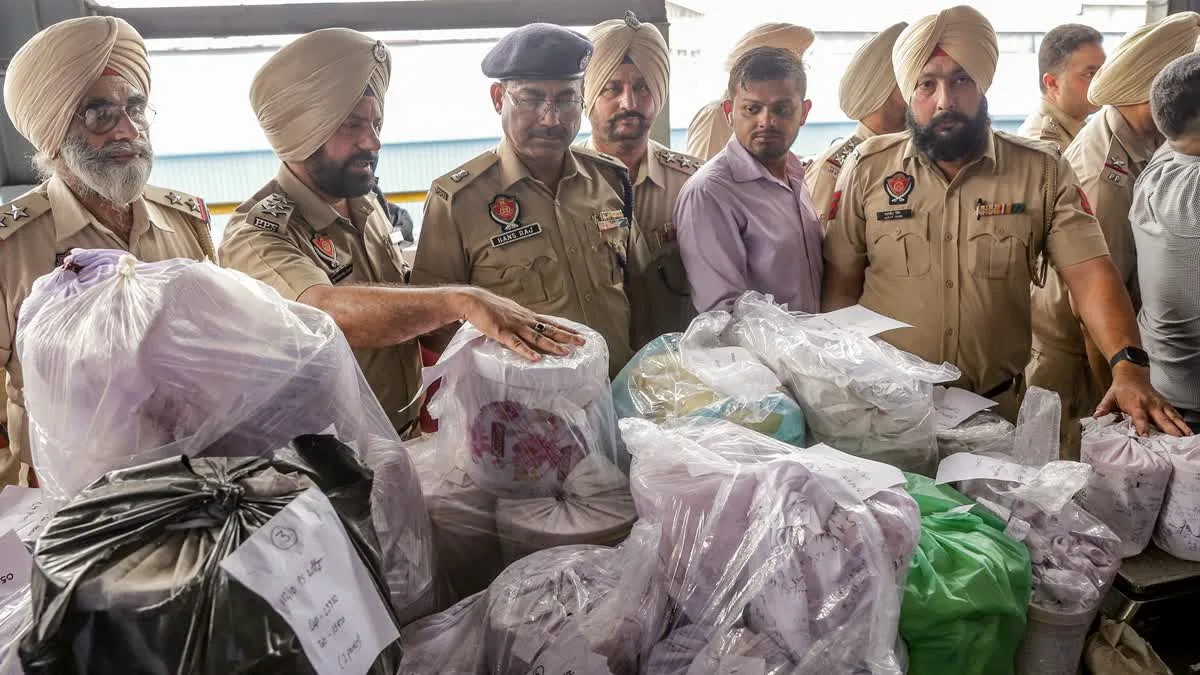
Punjab’s soil was once synonymous with valour, courage, hard work, enterprise and indomitable spirit. Its young men laid down their lives defending the nation’s borders, while its farmers toiled tirelessly to fill the country’s granaries. Yet, today, the very identity of Punjab is increasingly being associated with the flourishing drug trade, the ruin of its youth and the growing influence of drug mafias. This is not merely a social tragedy confined to one state; it is a grave test of national security, administrative integrity and political will. In a state where the hands of young people once wielded swords, held ploughs and proudly carried the national flag, drugs have rendered countless hands helpless and plunged innumerable families into despair. The irony is deeply disturbing: when those entrusted with curbing the drug trade—the police themselves—come under suspicion following reports of heroin worth crores of rupees being recovered from a police officer’s residence, it sets alarm bells ringing across the entire system. The reported recovery of heroin worth ₹40 crore from the house of a police constable in Punjab points towards a disturbing rot within the system. This is not merely a criminal case; it raises serious questions about an establishment in which those appointed to prevent crime may themselves come under the shadow of suspicion. When the fence begins to devour the field, it is meant to protect, who will safeguard the crop?
If elements within the very police force responsible for apprehending drug traffickers become entangled in such allegations, the erosion of public trust is inevitable. An impartial investigation, identification of those responsible and stringent legal action are therefore indispensable. No individual can be declared guilty merely on the basis of an allegation; equally, no one who exploits the police uniform to commit a crime should be allowed to escape the reach of the law. The drug trade in Punjab has now spread its tentacles into neighbourhoods, villages and small towns. Once regarded as a problem largely confined to border areas or urban youth, drug abuse has become a far more pervasive crisis, aggravated by the availability of synthetic drugs and various other narcotic substances. A section of the younger generation is losing its health, education, employment prospects and future to addiction. In some homes, mothers are left mourning the loss of their children; in others, elderly fathers lose the support they had hoped to rely upon in their twilight years. Elsewhere, a family’s sole breadwinner, trapped in addiction, becomes dependent upon the very relatives who once depended on him. What could be more heartbreaking than the lamp meant to illuminate a home becoming the source of its darkness?
Drug addiction does not destroy an individual alone; it corrodes the entire family and hollows out the social fabric from within. The gravity of this crisis is also reflected in government figures and police operations. According to the available details, over a ten-month period, Punjab Police arrested 10,524 alleged drug traffickers, including 153 major operators. During this period, 790 kilograms of heroin, 860 kilograms of opium and other narcotic substances were seized, along with drug money worth more than ₹13 crore. Assets valued at over ₹208 crore, reportedly linked to the drug trade, were also subjected to enforcement action. These figures certainly indicate the scale of enforcement, but they simultaneously raise a fundamental question: how are such enormous quantities of narcotics continuing to enter the state?
If the availability of drugs and the grip of addiction remain undiminished despite so many arrests and seizures, the roots of the problem are clearly deep and entrenched. To avoid a situation in which the disease worsens even as the medicine is administered, the focus must extend beyond arrest statistics to a thorough investigation of supply chains, financial networks and possible political patronage. Punjab’s approximately 553-kilometre-long border with Pakistan connects this challenge directly with national security. The threat of narcotics and weapons being smuggled across the border through drones has made border management increasingly complex. Reports indicating that 183 drones had been seized along Punjab’s border so far in 2026 underscore the seriousness of this threat. It is imperative to dismantle trafficking networks operating from across the border, but it would be a grave mistake to place the entire responsibility on external forces while turning a blind eye to vulnerabilities within the state. If local traffickers, organised criminal syndicates and corrupt elements within the system are working in collusion, stringent border surveillance must be accompanied by equally uncompromising action within Punjab. Only an impartial investigation capable of separating fact from fiction can establish who is merely a pawn, who is a key player and who is orchestrating the entire operation from behind the scenes. The Aam Aadmi Party government in Punjab has made several claims regarding its campaign against drugs and its action against traffickers. The crucial question, however, is whether these claims have translated into the substantive change the people of Punjab expected. Promising a decisive war against drugs before assuming power is one thing; carrying that battle through to tangible results requires political will, administrative integrity and sustained accountability. If drugs remain readily available, young people continue to fall prey to addiction and trafficking networks repeatedly resurface, it is only natural to question the government’s strategy and its implementation. Raids, arrests and announcements alone cannot fulfil the dream of a drug-free Punjab. The true measure of the government’s success must be the extent to which the supply of narcotics has declined, the number of young people who have recovered through treatment and returned to normal life, and the effectiveness of action taken against major traffickers and those who may be shielding them. The fight against drugs must combine police reforms, modern technology, border security and financial investigations with an equally strong commitment to de-addiction centres, psychological counselling, employment opportunities and rehabilitation. Young people suffering from addiction cannot simply be dismissed as criminals; they must be offered treatment, support and a dignified opportunity to rebuild their lives. Public participation in villages, awareness campaigns in schools and colleges, and the active involvement of families can transform this campaign into a mass movement. At the same time, allegations of complicity or protection within the police and political establishment must be investigated impartially at every level. Freeing Punjab from the grip of drugs is not merely the responsibility of the government; it is a collective obligation of society. Nevertheless, the foremost responsibility for leadership and accountability rests with the government. When law enforcers themselves begin to fall under a cloud of suspicion, and the recovery of heroin worth crores raises troubling questions about the credibility of the system, postponing introspection becomes an act of self-destruction. The time has come to move beyond merely going through the motions and deliver decisive results. Punjab needs neither hollow slogans nor publicity-driven campaigns; it needs uncompromising action, transparent investigations and accountable governance. To uproot the drug mafia, the walls of political patronage must be broken down, and the full force of the law must reach every offender, irrespective of position or influence. Otherwise, this devastating drug menace will continue to destroy not only Punjab’s youthful strength but also the social fabric and national security of the entire country.