
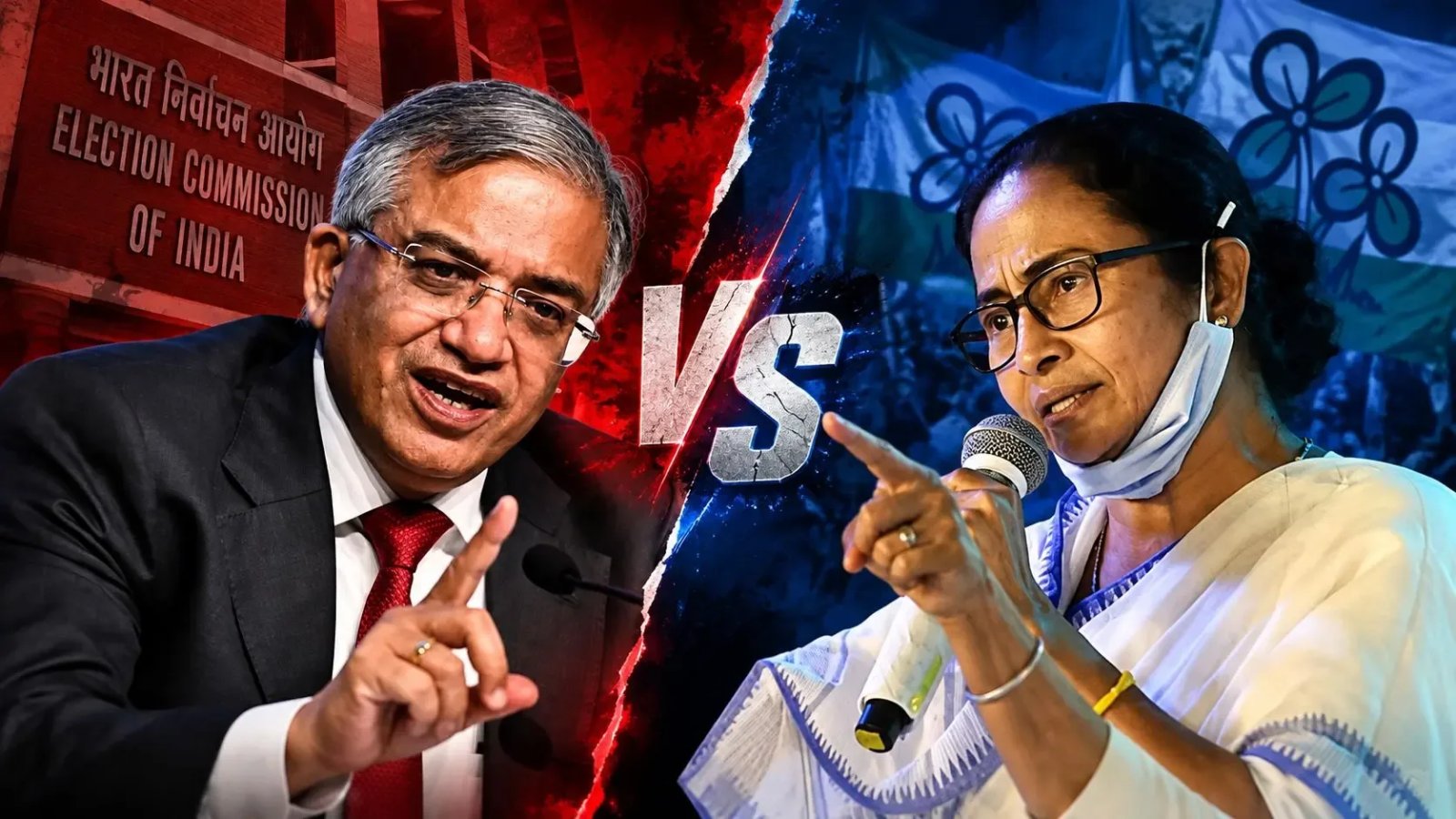
Mamata Banerjee’s political journey—from a fearless figure of student politics to the Chief Minister of West Bengal and, now, a leader confronting formidable political and legal challenges—has been one of the most remarkable stories in contemporary Indian politics. The woman once known as “Didi,” who challenged and eventually displaced the Left Front’s 34-year political dominance in Bengal, is today facing one of the most difficult phases of her political career. The 2026 West Bengal Assembly election marked a major turning point. The Trinamool Congress suffered a decisive electoral setback, while the BJP emerged as the governing force in the state. Banerjee herself lost Bhabanipur, a constituency that had long been identified with her political base, to Suvendu Adhikari. Election data show Adhikari securing 73,917 votes against Banerjee’s 58,812. After 15 years in power, the loss has fundamentally altered the political landscape around her.
The second major challenge is the internal crisis within the Trinamool Congress. For decades, Banerjee was the party’s undisputed central figure and final decision-maker. But the electoral defeat exposed organizational tensions that had been building beneath the surface. The dispute eventually resulted in rival factions laying claim to the party’s identity and organizational control, transforming an internal disagreement into an institutional crisis. The Election Commission subsequently froze the original party name, All India Trinamool Congress, and its traditional “Flowers and Grass” symbol as an interim measure.
The freezing of the party’s name and symbol represents a particularly significant challenge because political symbols are not merely electoral identifiers; for regional parties, they often embody years of organizational work, public recognition and political identity. The Election Commission has temporarily assigned Banerjee’s faction the name “Mamata All India Trinamool Congress” and the “Football Player” symbol, while the rival faction has been given the name “Democratic Trinamool Congress” and the “Envelope” symbol for the forthcoming by-elections. Banerjee has challenged the Election Commission’s decision in the Supreme Court and described the development as a “black day” for democracy. The third dimension of her predicament is legal. Following the change of government, several complaints and FIRs have been registered against Banerjee over statements made during the election campaign and other political programmes. In June 2026, an FIR was registered in Kolkata following allegations that remarks made during an election-related programme could promote enmity between communities. Another FIR was registered in Siliguri over allegations concerning remarks about religion and religious sentiments. These remain allegations and legal proceedings; an FIR itself does not establish guilt.
There was also a legal confrontation surrounding a Trinamool Congress Chhatra Parishad rally in Kolkata in August. Police registered an FIR against Banerjee and organisers over alleged violation of a Calcutta High Court order governing the programme and the movement of supporters. At the same time, controversies surrounding the previous administration—including allegations relating to recruitment irregularities and other financial or administrative decisions—continue to remain part of the wider political debate. Such allegations need to be distinguished from proven wrongdoing and judged through the appropriate legal processes. Perhaps the most significant political challenge, however, is the erosion of the image that once constituted Banerjee’s greatest political capital. She built her identity as a leader who came from a modest background, fought powerful political establishments and presented herself as the voice of ordinary people, particularly the underprivileged and women. Her political persona was built around struggle, accessibility and resistance.
Over the years, however, controversies surrounding governance, allegations of corruption and disputes over issues concerning women’s safety and recruitment have generated political criticism. The teacher-recruitment controversy, in particular, became a major issue in Bengal politics. The cumulative effect of these controversies, combined with 15 years of incumbency, contributed to an environment in which questions about governance and public trust became central to the political contest. Yet Mamata Banerjee’s political character has never been defined by an easy acceptance of defeat. Her early life and political career were shaped by struggle. From her formative years in politics to her long campaign against the Left Front, she repeatedly demonstrated a willingness to remain on the streets and fight prolonged political battles. Even now, she has rejected the idea of political retirement and has indicated that she intends to continue the struggle.
Her response to the changing political circumstances is also reflected in her evolving electoral strategy. Ahead of the forthcoming by-elections, Banerjee’s faction withdrew its candidate in Nandigram and extended support to the Congress candidate, indicating a willingness to work with another opposition party in the changed political circumstances. This represents a notable shift from the political positioning that characterized much of her earlier relationship with the Congress. Mamata Banerjee’s place in Indian political history has been shaped by her ability to build a powerful regional movement almost from scratch. She broke away from the Congress in 1998, established the Trinamool Congress and eventually succeeded in ending more than three decades of Left Front rule in West Bengal. For 15 years, she remained the dominant political force in the state. The same political journey that once symbolized an extraordinary rise is now confronting an equally extraordinary test.
The present crisis, therefore, is larger than an electoral defeat. It encompasses loss of power, organizational fragmentation, the battle over the party’s name and symbol, legal proceedings, questions about political credibility and the challenge of rebuilding a political base. The Election Commission’s interim decision has added a new dimension to the struggle, while the Supreme Court proceedings may determine an important part of the immediate institutional battle. The defining question for Banerjee now is not simply whether she can return to power. It is whether she can rebuild the political organization and public confidence that sustained her for so many years. Her greatest strength has historically been her capacity to convert adversity into political mobilization. But the present challenge is different: the struggle is no longer merely against an external political opponent. It is also about holding together a fractured organization and preserving a political legacy that she herself built over decades.
Mamata Banerjee has survived many political storms. Her present circumstances constitute perhaps the most demanding test of her political career. Whether she can once again transform adversity into an opportunity for political renewal will depend on how she responds to the organizational rupture, legal battles, changing alliances and questions of public trust. Her political story, therefore, is not simply a story of power gained and power lost. It is a story of a leader confronting the hardest question in politics: when the familiar symbols, structures and certainties disappear, can the political movement itself be rebuilt?