
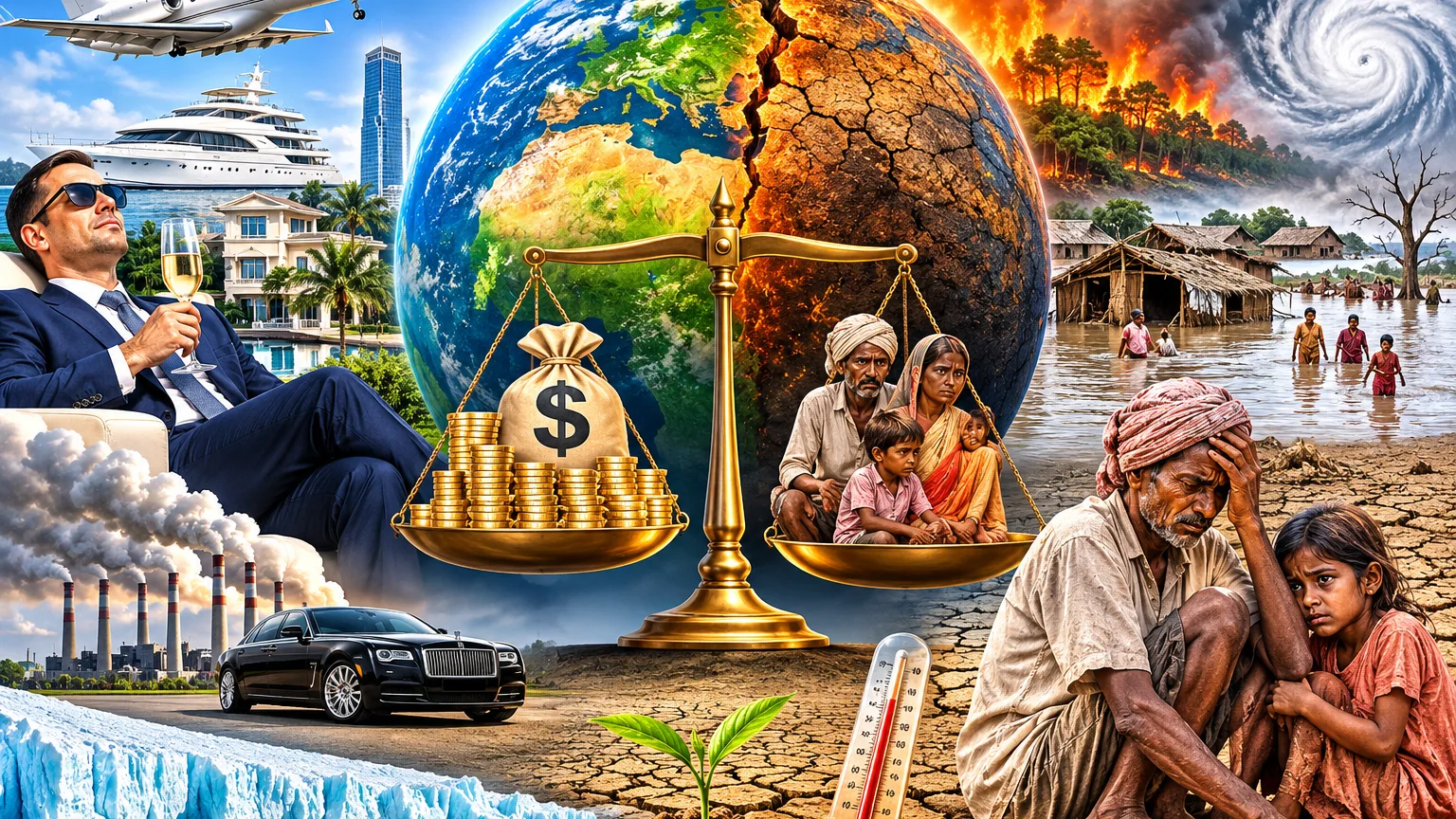
The world today is passing through an era of profound contradictions. On the one hand, remarkable milestones are being achieved in development, prosperity and modernisation; on the other, poverty, hunger, violence, displacement and environmental destruction are becoming increasingly alarming. This raises a fundamental question: when the world possesses abundant resources and science and technology have made unprecedented advances, why are millions of people still struggling to secure even the most basic necessities of life? The international organisation Oxfam, through its report ‘The Disaster Divide’, offers an uncomfortable yet thought-provoking answer. It reveals that the climate crisis is not merely the consequence of nature's fury, but is also deeply rooted in economic inequality, excessive consumption and the growing concentration of resources and power in the hands of a privileged few.
The report highlights how the lifestyles and investments of the world's wealthiest 0.1 per cent—approximately eight million people—are contributing disproportionately to carbon emissions, with consequences extending to billions across the globe. According to the report, this privileged group is responsible for more carbon pollution than the poorest 44 per cent of the world's population. This disparity is not merely a statistical difference; it is a disturbing reflection of human insensitivity, in which the entire world is being made to pay for the extravagant lifestyles of a handful of people. Private jets, luxury yachts, excessive energy consumption and investments in polluting industries have become symbols of modern affluence, while millions of people struggle for clean air, safe drinking water and two square meals a day. The real question is not how much wealth an individual possesses, but who bears the social and environmental cost of that prosperity.
The most alarming dimension of this crisis is that climate disasters, too, are increasingly exposing the divide between the rich and the poor. A flood may strike a wealthy person's luxurious mansion and a poor person's modest dwelling at the same time, but its consequences are vastly different. The wealthy can relocate to safer places, rely on insurance and use modern facilities to recover their losses. The poor, however, often lose their homes, agricultural land, livestock and livelihoods, pushing them years behind in their struggle for survival. According to Oxfam, countries with greater economic inequality experience up to seven times more flood-related deaths. The report further estimates that emissions generated by the world's richest one per cent could lead to approximately 1.9 million additional heat-related deaths in the future. An estimated 78 per cent of these deaths are likely to occur in low- and lower-middle-income countries. Thus, those who contribute least to the climate crisis are often forced to bear its most devastating consequences.
The widening gap between the rich and the poor is not confined to environmental concerns. When resources, opportunities and rights are distributed unjustly, social discontent inevitably takes root. Unemployment, inflation, food insecurity, water scarcity and displacement intensify social tensions. Gradually, these tensions can manifest themselves in anger, rebellion, crime, communal conflicts and violence. It would be simplistic to attribute every form of violence solely to economic inequality. However, when the benefits of development remain concentrated in a few hands while the burden of crises falls upon the overwhelming majority, the foundations of social harmony and stability are bound to weaken. Ironically, some major investors first accumulate enormous profits through polluting industries and subsequently find opportunities to profit from disaster management, environmental clean-up and reconstruction. Oxfam's ‘Destroy and Rebuild Index’, which examines 217 companies, investigates this disturbing pattern of double profiteering. It raises serious questions about an economic system in which a disaster becomes a business opportunity for some, while turning into a lifelong tragedy for others.
In the Indian context, this warning assumes even greater significance. A substantial section of India's vast population depends on agriculture, construction, small businesses and the informal sector for its livelihood. Farmers are battling erratic rainfall, droughts, floods and rising temperatures. Labourers are compelled to work in extreme heat, while families living in urban slums face the combined hardships of waterlogging and scorching temperatures. According to the World Bank, more than 80 per cent of India's population lives in districts vulnerable to climate-related disasters. Furthermore, approximately 76 per cent of the population residing in 57 per cent of the country's districts faces high or very high risks from extreme heat. These figures underline the scale of India's vulnerability and the urgency of a comprehensive response.
For India, the challenge is not merely to accelerate the pace of economic growth, but to ensure that development is equitable, inclusive and environmentally sustainable. The vision of a Viksit Bharat 2047 will acquire real meaning only when the benefits of progress reach the person standing at the very end of the social and economic spectrum. If metropolitan cities continue to set new benchmarks of luxury and conspicuous consumption while farmers in villages struggle for water, electricity and sustainable livelihoods, the picture of development will remain incomplete. India, aspiring to emerge as a Vishwaguru and a guiding force for the world, must demonstrate that economic prosperity and environmental conservation can coexist in a balanced and sustainable framework.
Achieving this requires certain fundamental policy priorities. The accountability of affluent sections and highly polluting industries must be clearly established. An appropriate taxation framework should discourage excessive luxury consumption, while clean and renewable energy must receive greater encouragement. The conservation of water, forests and land must become an essential condition of development rather than a secondary consideration. Equally important is the need to establish effective systems of social security, insurance, healthcare and rehabilitation for farmers, labourers and vulnerable communities affected by climate disasters. The benefits of economic growth must not remain confined to the owners of capital; they must also reach the hands that create wealth through their labour. Development cannot be considered meaningful if those who contribute most through their hard work remain deprived of its rewards.
India's civilisational wisdom has long upheld the ideals of ‘Sarve Bhavantu Sukhinah’ (May all be happy), ‘Vasudhaiva Kutumbakam’ (The world is one family) and ‘Aparigraha’ (non-possession and restraint). Mahatma Gandhi's philosophy of ‘Simple Living and High Thinking’ is not merely a message for individual conduct; it represents a broader vision of the judicious use of resources and social responsibility. The Jain philosophy of Aparigraha likewise teaches that accumulation beyond one's genuine needs ultimately creates imbalance and injustice in society. Nature is not our personal property; it is a precious inheritance entrusted to us for future generations. These values offer a meaningful moral foundation for addressing the challenges of a world increasingly driven by excessive consumption and limitless accumulation.
Ultimately, Oxfam's ‘The Disaster Divide’ places a fundamental moral question before humanity: Can development mean unlimited prosperity for a privileged few alongside growing deprivation and helplessness for the overwhelming majority? The Earth is not the private estate of any particular class, nor can its resources become the exclusive preserve of a handful of powerful individuals. The need of the hour is not to treat wealth itself as a crime, but to make prosperity inseparable from accountability. We must remember that when the gulf of inequality becomes too deep, the resulting discontent cannot remain confined within geographical or political boundaries. Its consequences can threaten social harmony, economic stability and global peace. If we are to save our planet, we must change the direction of development, connect prosperity with compassion and make the global economic system accountable to humanity. Economic progress must be measured not merely by the accumulation of wealth, but by the quality of life it creates, the dignity it ensures and the environment it preserves. The true measure of a prosperous society lies in how it treats its most vulnerable people and how responsibly it uses the resources entrusted to it. For development that neither protects nature nor safeguards human dignity is not progress; it is merely a prelude to destruction.