
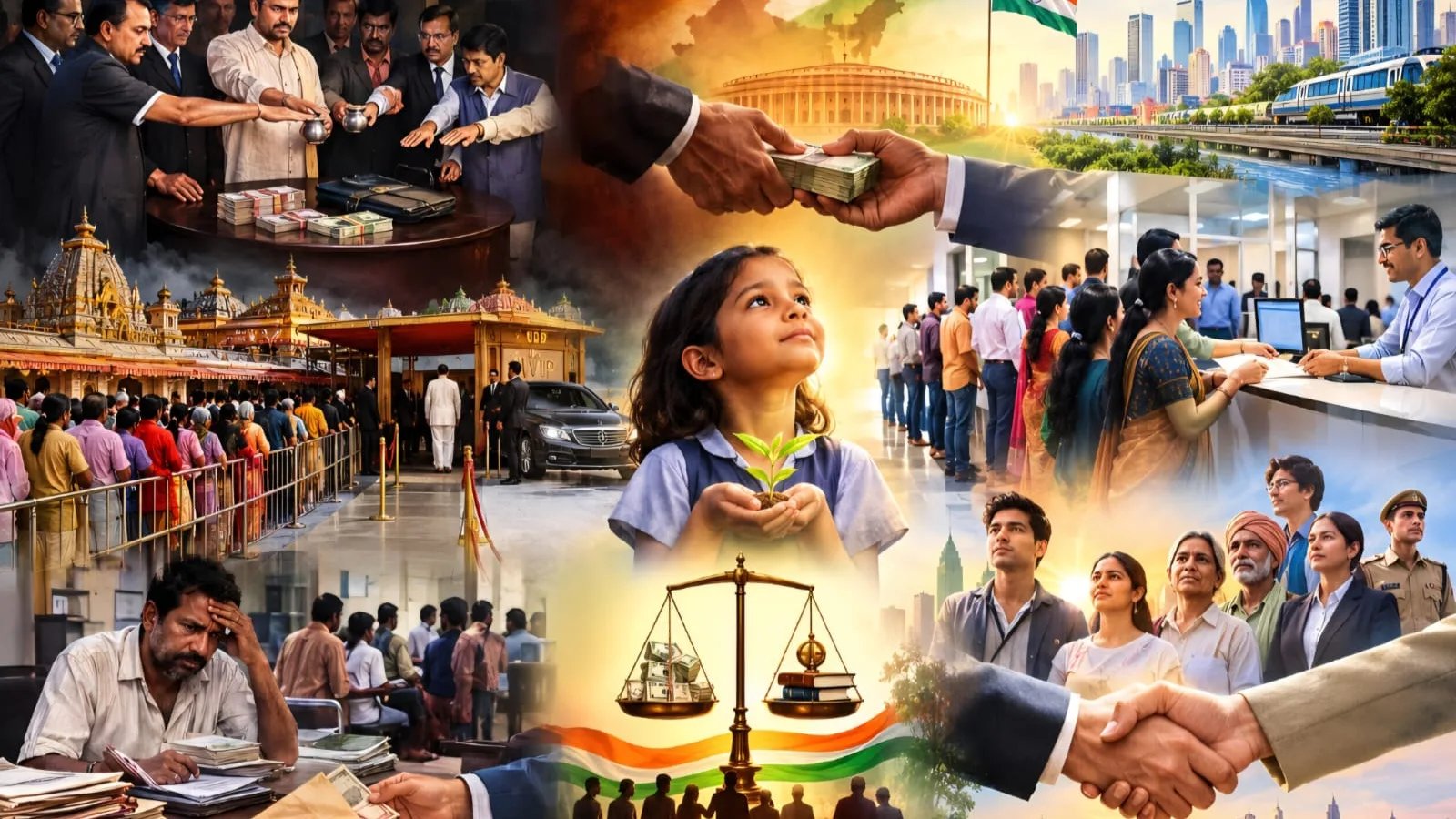
The most dangerous moment in the fight against corruption is not when an individual steals public money, but when society begins to regard such conduct as normal. When a bribe is called a “facilitation fee,” commission is described as “the system,” political influence becomes a “recommendation,” and breaking rules is celebrated as an “art of getting things done,” corruption ceases to be merely a legal problem. It becomes a crisis of social values. A purported video from Shahjahanpur, Uttar Pradesh, has brought this disturbing mindset into sharp focus. The video appears to show some people taking a pledge to divide municipal revenue among themselves. The administration has ordered an inquiry, and the circumstances and authenticity of the video are being examined. Therefore, any final conclusion must await the outcome of the investigation. Yet the episode raises a much larger question: Has corruption become so emboldened that people can allegedly pledge not merely to indulge in it, but to share its proceeds? If individuals associated with a public institution begin viewing public money as their private entitlement, it is a serious warning for democratic governance.
Prime Minister Narendra Modi publicly articulated the resolve in 2014: “Na khaunga, na khane dunga” — neither will I indulge in corruption nor will I allow it. Since then, various institutional and digital measures have been emphasised to combat corruption. The Union government has repeatedly spoken of a policy of zero tolerance. The Lokpal has a statutory role in dealing with corruption complaints, while the Central Vigilance Commission plays an important role in vigilance and preventive oversight. Yet one fundamental question remains: Can laws and technology eliminate corruption if society continues to tolerate it? The cost of corruption is not borne only by the government treasury. Its biggest victim is the ordinary citizen who stands in queues, pays taxes, follows rules and expects justice from the very system he supports. If a road that should have been built properly is constructed with substandard material, citizens pay the price. If medicines meant for a government hospital are unavailable, it is the poor patient who suffers. If an official demands money for a service that should be delivered on time, the citizen's dignity is violated.
Transparency International's 2025 Corruption Perceptions Index gave India a score of 39 out of 100 and ranked it 91st among 182 countries. Its Global Corruption Barometer data also reported that 39 per cent of public-service users surveyed had paid a bribe during the preceding 12 months; however, these figures relate to its 2020 Asia survey and should not be treated as a direct measurement of the situation in 2025 or 2026. Such statistics are warnings, but an even deeper concern is the social psychology surrounding corruption. Many people oppose corruption only when they themselves become its victims. When paying money makes a government process faster, the very system we condemn can suddenly appear convenient. That is how corruption acquires social acceptance. Corruption has an economic face, but it also has a face shaped by power and privilege. The use of political or social influence for personal convenience weakens the principle of equality. A visible example is the culture of VIP access at religious places. At many prominent temples, ordinary devotees may wait for hours in queues while influential visitors receive special arrangements. This is not merely a question of temple management; it touches upon the democratic principle of equality. In matters of faith, status should not determine spiritual access. Exceptions may understandably be necessary for security, persons with disabilities, senior citizens or specific official responsibilities, but clear and uniform standards are needed to prevent privilege from becoming an entitlement.
Democracy cannot mean that a privileged few are permanently allowed to move ahead while ordinary citizens remain in queues. Digital India has brought many public services online, reducing direct interaction between citizens and officials and creating greater possibilities for transparency. But technology by itself is not a cure. Wherever procedures remain complicated, official discretion is excessive or grievance redressal is ineffective, new forms of corruption can emerge even within digital systems. In areas such as GST administration, transparency, clear rules, risk-based scrutiny and accountability remain essential. This does not mean that an entire department is corrupt. It means that every large administrative system must be designed so that honest officials are protected and corrupt conduct becomes difficult to conceal.
The real remedy is not limited to raids and suspensions. It lies in reducing discretionary powers, increasing transparency, ensuring time-bound public services, creating digital tracking, strengthening independent grievance redressal and fixing responsibility for decisions. Institutions must be designed in such a way that integrity is easier to practise than corruption. India now needs a new kind of pledge—not one confined to ceremonial occasions, but one reflected in everyday governance: Public office is not a privilege; it is a responsibility. Authority received from the people is not a means of personal gain; it is an opportunity to serve them. Public money belongs first to the public. We will neither take nor facilitate bribes, nor protect those who indulge in corruption. Political parties, too, have a crucial responsibility. Their greatest test should not merely be electoral victory, but the preservation of public trust. Alongside the legal principle that allegations must be established through due process, political organisations need credible ethical standards for public conduct. Administrators must demonstrate that honesty is not merely an individual's personal virtue but an institutional culture.
Yet corruption is not created only by politicians and officials. Society also prepares the ground on which corruption flourishes. When parents tell children, “Get the work done somehow”; when we take pride in bypassing rules; when we seek special treatment through personal connections; when we pay a bribe to get our own work completed quickly and then complain about corruption the next morning—we strengthen the very system we claim to oppose. Therefore, the fight against corruption cannot be a contest between government and citizens. It must become a shared national responsibility involving government, administration, political parties, judiciary, media, business and civil society. The Lokpal's 2025 message—“Empower Citizens, Expose Corruption”—captures an important dimension of this struggle. Corruption can be weakened only when citizens who report wrongdoing feel empowered rather than helpless. An aware and courageous citizen is not an obstacle to governance; he is an essential pillar of accountable governance.
India is aspiring to become a developed nation by 2047. A developed India cannot be defined merely by skyscrapers, modern highways, large industries or a powerful economy. A truly developed India will be one where a citizen does not have to pay anyone to obtain a legitimate right; where public office represents responsibility rather than privilege; and where the law does not operate differently for the powerful and the ordinary. The Shahjahanpur video remains a matter for investigation. If the alleged pledge to divide public revenue is established as genuine, it would represent not merely the alleged misconduct of a few individuals but a grave warning about the ethical health of public life. If, on the other hand, the video is found to be misleading or edited, the incident would still underline the depth of public distrust surrounding corruption. The councillors concerned have also alleged that the video was edited and intended to defame them. That makes an impartial investigation all the more important.
The answer, therefore, is not more speeches about corruption but better systems, stronger institutions and more responsible citizens. We must create an environment in which corruption is difficult to commit, difficult to conceal and increasingly difficult to socially justify—while honest conduct becomes the easiest and most respected path.The real freedom of a nation will be achieved when a citizen does not have to stretch out his hand before anyone merely to obtain what is rightfully his. We do not need a pledge to share corruption; we need a culture of integrity. Not merely “I will neither take nor allow corruption,” but also “I will neither tolerate nor silently accept it.” Such a citizens' resolve can become the ethical foundation of a truly developed and democratic India.