
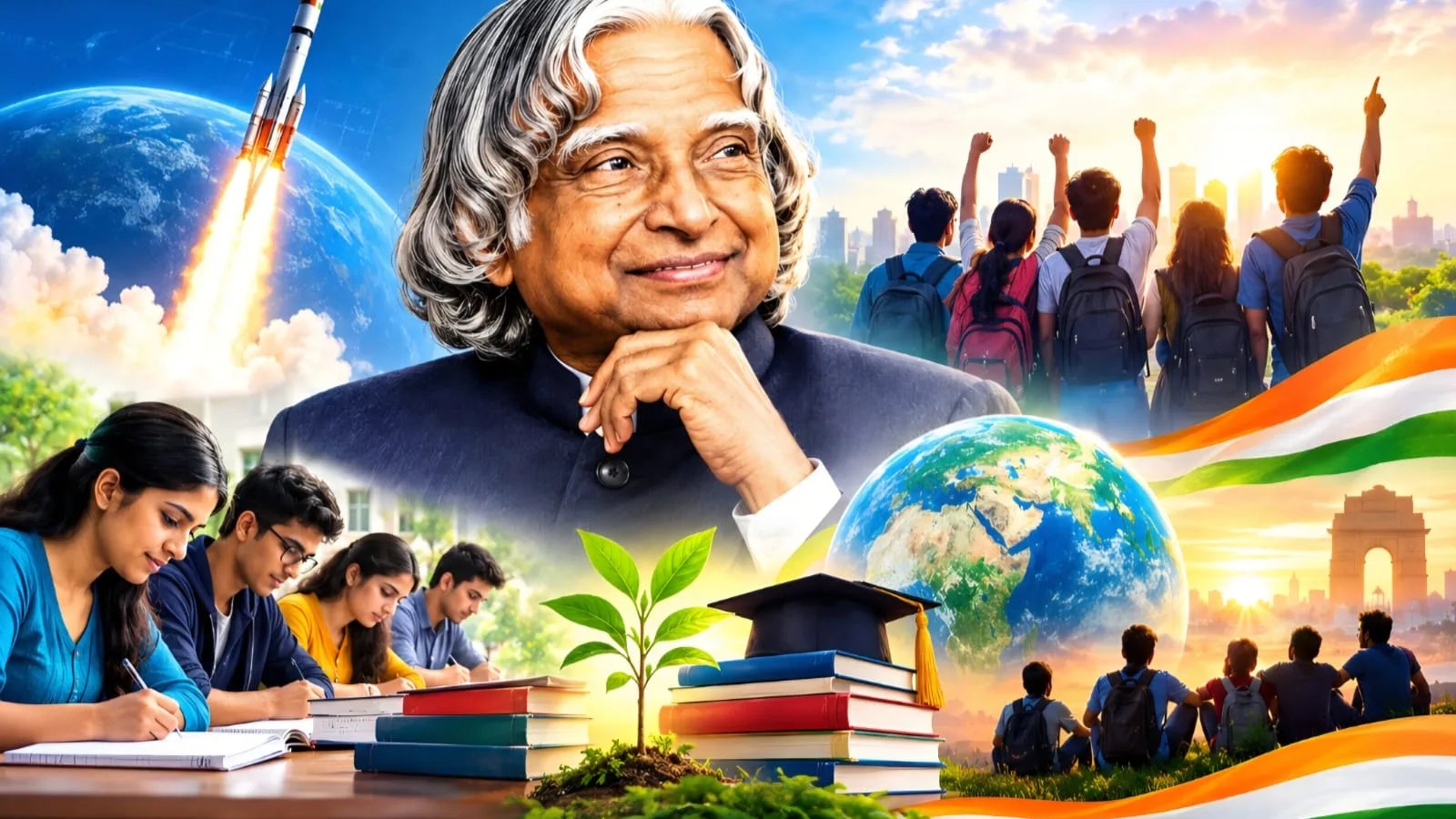
The future of a nation is determined less by the laws passed in its legislatures than by the character of the students being shaped in its educational institutions. Students are not merely a country’s young population; they are its living capital of possibilities, ideas, values and progress. The dreams nurtured in their eyes have the power to shape the destiny of a nation, while the future fashioned by their hands determines the course of civilization. Yet, when those very hands begin to wield instruments of destruction instead of creation, when the thirst for knowledge gives way to the impulse for violence, and when indiscipline and disorder take root in the temples of learning, the crisis extends far beyond student life. It becomes a warning signal for the conscience of society and the nation. In this context, World Students’ Day offers an important opportunity for introspection. Observed in India on October 15, the birth anniversary of Dr. A.P.J. Abdul Kalam, the former President of India, eminent scientist and the legendary ‘Missile Man’, World Students’ Day is widely associated with his profound commitment to education, young people and their aspirations. Although the United Nations has not officially designated it as an international observance, the day is celebrated in India as a tribute to Dr. Kalam’s student-centric vision and his unwavering faith in the transformative power of education. For him, students were not merely individuals striving to secure marks in examinations; they were dreamers endowed with the potential to transform the destiny of the country. He loved interacting with children, listening to their questions, encouraging their curiosity and inspiring them to dream big. He firmly believed that dreams are not what we see while sleeping, but what keep us awake and inspire us to pursue our goals. His own life stands as compelling evidence that a person born into modest circumstances can make history through extraordinary determination, knowledge and perseverance.
Dr. Kalam’s mission extended far beyond scientific achievements. His larger vision was to transform India into a developed, self-reliant, knowledge-driven and ethically strong nation. He sought to inspire young people to embrace scientific thinking, innovation, self-confidence and nation-building. In his view, the purpose of education was not merely to equip individuals with the skills necessary to earn a livelihood, but also to cultivate wisdom, compassion, character and a sense of responsibility. He wanted every student to recognize their inherent potential, learn from failure and channel their energies towards solving society’s problems. The question we must ask today is whether our education system and student politics are moving in the direction of fulfilling his vision. One disturbing aspect of the contemporary scenario is the growing concern over incidents of violent confrontation, vandalism, substance abuse, indiscipline and displays of brute force in educational institutions. It would, however, be unfair to suggest that the entire student community is caught in this destructive trend. The same generation is making remarkable contributions to science, technology, sports, environmental conservation, entrepreneurship and social service. Nevertheless, whenever the creative energies of students are squandered on destructive activities, society must examine the underlying causes. If the age meant for groundbreaking discoveries in laboratories is instead spent turning educational campuses into battlegrounds, it signals a collective failure on our part.
The history of student movements demonstrates that the voices of young people have often given fresh impetus to social transformation, democratic rights and issues of public interest. Raising one's voice against injustice, demanding accountability from institutions and organizing around educational concerns are legitimate and constructive expressions of student life. However, there is a fine yet decisive line between a movement and anarchy. When argument gives way to aggression, dialogue to confrontation, and protest to violence, the original objective recedes into the background while ego takes centre stage. The right to dissent is indispensable to democracy, but damaging public property, humiliating teachers or disrupting the education of fellow students cannot be justified in the name of dissent. One cannot create light by setting a fire, nor strengthen a tree by cutting off its branches.
Blaming students alone for this situation would also be an oversimplification. A lack of communication within families, the increasing commercialization of education, uncertainty about employment, mounting psychological pressure, the glorification of aggression on social media, easy access to intoxicating substances and the interference of vested interests in student politics may all aggravate the crisis. When young people are not provided with constructive avenues for channeling their energies, they may drift towards frustration, anger or destructive imitation. The familiar proverb that ‘an idle mind is the devil’s workshop’ may not hold true in every circumstance, but purposeless energy can certainly lead to distraction and misdirection. Students, therefore, need more than sermons and moral lectures; they need opportunities, mentorship, trust and meaningful participation in society. In this regard, the Jain principles of ahimsa (non-violence), anekantavada (the philosophy of multiple perspectives) and self-discipline acquire special relevance. In the Jain tradition, non-violence is not limited to refraining from physical harm; it also demands restraint in thought, speech and conduct. Anekantavada teaches us that understanding the truth requires listening to other perspectives and acknowledging the limitations of our own viewpoints. If these values become an integral part of student life, differences will not degenerate into hostility, and opposition will become a means of dialogue rather than confrontation. Students will learn that true courage does not lie in defeating another person, but in conquering one's own anger, impulses and ego.
A genuine tribute to Dr. Kalam on World Students’ Day would be to liberate education from the narrow confines of examination-oriented learning and restore its larger purpose of building character and shaping lives. Schools and colleges must encourage libraries, laboratories, sports, art, literature, social service and innovation. Awareness against substance abuse, open conversations about mental well-being, trust between teachers and students, and respect for democratic norms in student politics are equally essential. By involving students in solving local problems, protecting the environment, educating underprivileged children and serving their communities, we can provide their energies with a constructive field of action. Educational institutions must also ensure an environment that is safe, just and accountable, because discipline does not mean repression, just as freedom does not mean unrestrained licence.
Dr. Kalam’s philosophy of student empowerment reminds us that nation-building is not the solitary mission of a leader, a government or a scientist; it is the collective endeavour of millions of awakened minds. The greatest challenge before students today is not merely to outperform others in competition, but to make their success meaningful. They must decide whether their talents will be used to unite society or divide it, whether their intellect will seek solutions or aggravate crises, and whether their courage will write a history of creation or a story of destruction.The real message of World Students’ Day is that youthful energy must not merely be controlled; it must be guided in the right direction. Only when students’ dreams are given wings, their curiosity is provided with opportunities, and their character is anchored in ethical values will education become the nation’s greatest strength. The future of a country is determined not merely by how much its students know, but also by whom they serve and for what purpose they use their knowledge. Dr. Kalam’s vision of India can become a reality only when classrooms nurture character, laboratories foster innovation, movements embrace responsibility, and the aspirations of young people give birth to a new culture of creativity and constructive action. That is the true significance of World Students’ Day, and that is the real foundation of a developed India.