
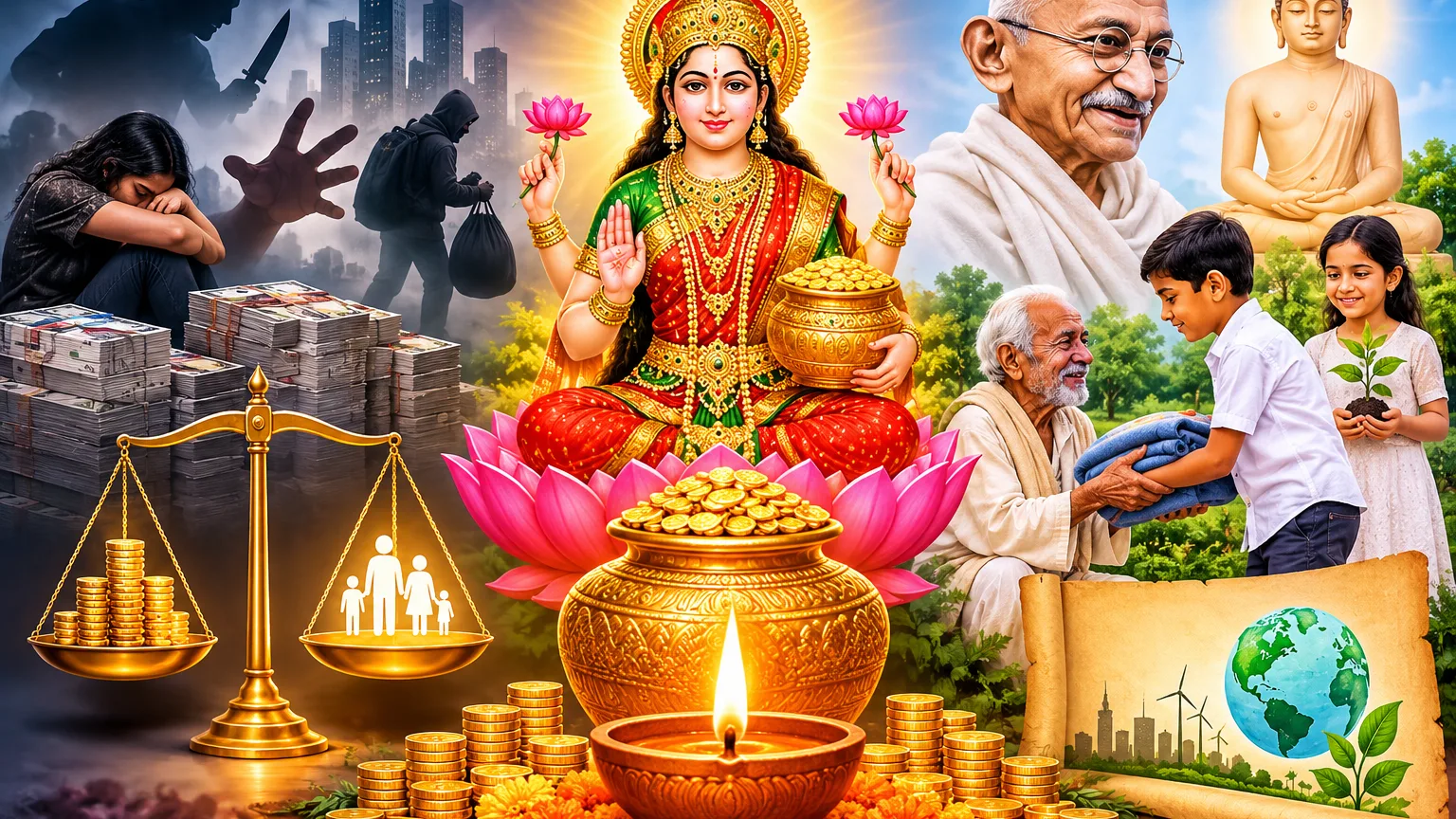
Dhanteras, the second significant festival associated with the five-day celebration of Diwali, is dedicated to the worship of Lord Dhanvantari and Goddess Lakshmi. It is also considered an auspicious day for shopping, charity and acts of benevolence. Known as Dhan Trayodashi and Dhanvantari Jayanti, Dhanteras is not merely the beginning of the Diwali festivities; it is an occasion to examine our attitude towards wealth. It reminds us that, in the Indian cultural ethos, wealth is a means, not the ultimate goal; prosperity is an ornament of life, not the very foundation of life. Unfortunately, in modern times, the meaning of wealth has become so narrow that it is increasingly associated not with compassion, integrity and contentment, but with accumulation, comfort, status and power. Economic prosperity has grown across the world, but has humanity become equally prosperous? The concentration of wealth in a few hands and widening economic inequalities have created a strange sense of insecurity in society. Material comforts have increased, but trust has declined. Resources have multiplied, but spiritual discipline has weakened. Houses have become larger, while hearts have gradually become smaller. As a result, violence, deceit, corruption, theft, exploitation, misconduct and limitless accumulation have begun to find space not merely in society, but within our own minds and lives. We may still recognize one another by our faces, but the identity of character is becoming increasingly blurred.
The true message of Dhanteras lies in correcting this contradiction. Indian thought has never opposed wealth; it has opposed its blind accumulation and its unethical use. In the Sanatana tradition, Lakshmi becomes truly auspicious when wealth is connected with dharma and the welfare of society. Lord Mahavira’s principle of Aparigraha reminds us that excessive accumulation ultimately turns a person from the master of possessions into their slave. Jain philosophy’s emphasis on restraint and limiting possessions is not merely a discipline for monks; it is an important way of life for householders as well. Mahatma Gandhi connected the question of wealth with his principle of Trusteeship. For him, the right to property was not merely a right to private consumption; it also carried a responsibility towards society. Wealth may belong to us in a legal sense, but its deeper meaning emerges only when it creates hope, dignity and opportunity in the lives of others. Therefore, the real question is not how much wealth we possess, but how much power our wealth exercises over our character—and how much right society has over the wealth in our possession.
Dhanteras is a festival of aspiration for prosperity. In this sense, it is also a celebration of the economy—the pursuit of a meaningful, balanced and qualitative economic order. On this day, homes and marketplaces are filled with hope, and the exchange of money and goods takes place with enthusiasm. There is a traditional belief that whatever is purchased on Dhanteras multiplies manifold. Scriptures and popular traditions associate this day with various practices believed to invite prosperity, abundance and the blessings of Goddess Lakshmi. Dhanteras dispels darkness, while Lakshmi represents the light of prosperity. According to the Indian spiritual tradition, every form of worship and reverence integrates three dimensions—the physical, the spiritual and the divine. Thus, the worship of Lakshmi during this festival is not merely a prayer for material wealth, but also a prayer for happiness, well-being, harmony and spiritual abundance.
According to Hindu mythology, Lord Dhanvantari, regarded as the divine originator of Ayurveda, emerged from the churning of the cosmic ocean carrying a pot filled with amrit, the nectar of immortality. This is one of the reasons why purchasing utensils on Dhanteras has become a cherished tradition. Hindu traditions also hold that Goddess Lakshmi emerged from the cosmic ocean during the churning on this very occasion. Hence, purchasing gold and silver on Dhanteras is believed to invite her blessings and bring peace, prosperity, happiness and good fortune into the home. Many families continue their centuries-old traditions by purchasing precious metals and worshipping Goddess Lakshmi as the embodiment of divine abundance and prosperity.
The very nature of Lakshmi is described as threefold. Her presence is reflected in the body, the mind and material wealth. Five forms of happiness are traditionally identified—physical well-being, mental peace, prosperity, harmonious family life and healthy children. Goddess Lakshmi, in her form as Kamala, is also described through eight manifestations: Adi Lakshmi or Mahalakshmi, Dhana Lakshmi representing wealth, prosperity, investment and economic well-being; Dhanya Lakshmi representing food and agricultural abundance; Gaja Lakshmi representing animals and natural wealth; Santana Lakshmi representing good fortune, health, longevity and prosperity; Veera Lakshmi representing courage, protection and security; Vijaya Lakshmi representing victory and achievement; and Vidya Lakshmi representing knowledge, learning, arts and sciences.
Together, these eight dimensions constitute the larger vision of Mahalakshmi and give deeper meaning to the celebration of Diwali—the festival of light. Where all these forms of prosperity shine together, there is true Diwali. It is a prayer for light, nourishment, progress and well-being. Let us understand this in another way. The presence of Lakshmi is found even in the smallest unit—in a humble earthen lamp, in its gentle flame and in the light it spreads. Diwali belongs as much to a poor person as it does to a wealthy one; it belongs as much to a potter as it does to a jeweller. This is the true Lakshmi—the Lakshmi of the heart, the Lakshmi that belongs to everyone. The deeper message is that the body, mind, wealth, family and children should all remain nourished and illuminated like a lamp—with an abundance of prosperity as well as an abundance of inner nectar and happiness.
Today, the real need is not merely to earn more wealth, but to ensure that wealth is earned through righteous means and used for noble purposes. If prosperity is the goal, the means must also be pure. Wealth acquired through dishonesty, exploitation, deceit or corruption may create a vast fortune, but it cannot bring lasting peace or genuine respect. In contrast, even limited wealth earned through hard work, honesty and ethical conduct can give life dignity. Dhanteras teaches us not only the importance of accumulation, but also the wisdom of circulation and sharing. Wealth that never reaches society eventually becomes stagnant. Its true worth increases when it is used for charity, service, education, healthcare, helping the needy, protecting the environment and contributing to social development. Like a lamp, wealth becomes meaningful only when it helps illuminate the lives of others. Therefore, on Dhanteras, we should not ask only, “How much has our wealth increased this year?” We should also ask: Has our contentment increased? Has our character become stronger?Has our compassion become deeper? How many lives have been touched by the wealth we possess?
We may not own a luxury car, a mansion or a high position—and that is perfectly fine. But we must possess honesty, humanity, self-respect, restraint and character. These are the forms of wealth that neither the marketplace can buy nor time can take away. The lamp of Dhanteras will truly shine when, alongside wealth, the light of dharma illuminates our lives; alongside prosperity, compassion; alongside enjoyment, restraint; and alongside rights, responsibility. Material wealth can make life comfortable, but the wealth of character is what makes life truly great. This is the eternal message of Dhanteras—and perhaps the greatest need of modern society.