
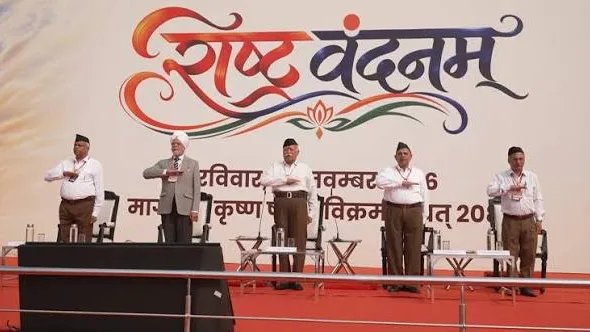
The ‘Rashtra Vandanam’ programme, organised on November 29, 2026, at ‘Samarasata Sthal’ in Sector 23, Rohini, Delhi, marked not merely an important milestone in the centenary journey of the Rashtriya Swayamsevak Sangh (RSS), but also presented a broader vision of India’s path towards the next century. The event was remarkable in its scale, discipline, organisation and ideological message. Along with a large gathering of uniformed RSS volunteers, people from different walks of life participated in the programme. Former Chief Justice of India, Justice Jagdish Singh Khehar, was also present. The contribution of thousands of volunteers in preparing for the event, the arrangement of multiple entry gates, the management of different functional zones and the smooth handling of a massive gathering demonstrated that an event of such magnitude becomes truly meaningful only when supported by a strong foundation of organisation, training and discipline.
The most significant message of RSS chief Dr. Mohan Bhagwat’s address was his assertion that completing 100 years should not be viewed merely as an occasion for celebration, but as an opportunity to intensify efforts for the welfare of society. This statement can be regarded as the central theme of the entire programme. A centenary may be a milestone for any organisation, but its significance multiplies when it becomes a stepping stone towards a greater mission. The Sangh has sought to utilise its centenary year as an opportunity to expand social outreach, strengthen public engagement and deepen dialogue with different sections of society. In other words, a centenary is not about looking back and merely counting achievements; it is about looking ahead and recognising greater responsibilities.
The spirit of ‘Nation First’ emerged prominently in Bhagwat’s address. Family, caste, region and political affiliations may each have their own importance, but the larger consciousness of the nation must remain above all these identities. This thought assumes particular significance in today's socially and politically divided atmosphere. Differences of opinion are a natural part of democracy, but ensuring that differences do not turn into divisions of hearts and minds is the real test of Indian culture. India's strength has never rested in uniformity, but in the underlying unity that binds its extraordinary diversity. National unity, therefore, does not mean making everyone identical; it means nurturing mutual respect, sensitivity and a sense of responsibility while allowing different identities and traditions to flourish.
This is precisely where the message of ‘Rashtra Vandanam’ transcends the boundaries of the RSS and becomes relevant to the entire nation. If every citizen, despite having multiple layers of identity, regards the nation as the highest collective identity, the walls of caste, language, region, religion and political differences can gradually weaken. Diversity is not a weakness of India; it is one of the defining strengths of its civilisation. What is essential is that the branches of diversity remain connected to the roots of national unity. Branches may appear green and flourishing, but once disconnected from their roots, their future cannot remain secure.
Bhagwat also laid special emphasis on the aspirations of the younger generation. He observed that today's youth wants India to emerge as a leading nation in the world and considers the nation its foremost priority. This should not remain merely an emotional declaration; it must translate into national character, dedication and a strong sense of responsibility. The dream of making India a global leader cannot be the responsibility of governments or institutions alone. Scientists, farmers, entrepreneurs, teachers, students, workers, artists, spiritual leaders and ordinary citizens alike must strive for excellence, integrity and national interest in their respective fields. The future of a nation is written not merely in the proceedings of Parliament, but also in the values and character of its society.
Bhagwat’s perspective on India's global role was equally significant. He mentioned that during the centenary year, the Sangh had reached out to different countries across five continents to engage in dialogue about India, the RSS and its activities. This reflects the growing interest in India not merely as an economic or strategic power, but also as a civilisation with a distinctive cultural and spiritual vision. According to his message, many societies across the world, including those in the West, are keen to understand and learn from India's values of family, coexistence, patience and its holistic outlook towards life.
This places a significant responsibility on India. If the world is looking towards India, it will not be enough to merely proclaim the greatness of our ancient traditions. India must demonstrate how those timeless values can be meaningfully integrated into contemporary life. Swami Vivekananda introduced the world to India's spiritual strength, while Sri Aurobindo envisioned India as a living laboratory for the larger evolution of humanity. Today, that vision must be translated into tangible achievements across science, technology, economy, education, environmental protection, social justice and ethical living. India must establish its capabilities in every sphere while remaining rooted in its civilisational wisdom.
One of the most inspiring aspects of the RSS programme was its exemplary organisational discipline. Bringing together such a massive gathering, managing entry and movement, assigning responsibilities to volunteers, coordinating with security agencies and conducting the entire programme within a disciplined time frame was, in itself, a valuable lesson in management. Discipline does not simply mean standing in a queue; it means fulfilling one's responsibilities punctually, sincerely and without unnecessary display. This was one of the remarkable features of the Sangh's working methodology that the event brought into focus. When thousands of people consider themselves not masters of an arrangement but active participants in it, a mere crowd is transformed into an organised collective force. This lesson holds immense relevance for every large social gathering, institution and public campaign.
Another important dimension of the programme was its emphasis on social harmony and the initiative of ‘Panch Parivartan’ (Five Transformations). The key themes associated with the event included social harmony, family awareness and values, environmental protection, promotion of Swadeshi and the fulfilment of civic duties. The emphasis on tree plantation and social initiatives such as de-addiction indicates that nation-building is not merely a matter of ideas and declarations; it requires meaningful changes in everyday conduct and lifestyle.
India's greatest challenges today are not necessarily external; many lie within society itself. Economic growth may accelerate, technological capabilities may expand and India's influence on global platforms may increase. However, if distrust, bitterness, caste divisions, addiction, indifference towards the environment and neglect of civic responsibilities continue to grow within society, the brilliance of development will remain incomplete. Social transformation, therefore, must begin with individual transformation. Nation-building is not merely about constructing roads, buildings and industries; it is fundamentally about building responsible, sensitive and enlightened human beings.
Perhaps the greatest message of ‘Rashtra Vandanam’ is that India's next journey must not be merely the journey of a government or an organisation, but the collective journey of the nation's social consciousness. The answer to the question of what India can offer to the world will not be found merely in economic statistics, but in the conduct and character of its people. Can we maintain respect even when we disagree? Can we protect nature while pursuing development? Can we embrace modern science while remaining connected to our traditions? Can we give equal importance to our duties alongside our rights? If the answers to these questions are affirmative, India's aspiration to become the ‘Vishwaguru’—the spiritual, intellectual and moral guide of the world—will cease to be merely a slogan and evolve into a way of life.
The centenary flame has been lit. The real challenge now is to determine how far its light can reach. For the RSS, the completion of 100 years does not signify the conclusion of a journey, but the beginning of a new chapter in its 101st year. For India too, this is a moment to combine pride in its past with a deeper sense of responsibility towards the future. Before showing the world a path, India must first bring clarity and direction to its own inner journey.
The true meaning of ‘Rashtra Vandanam’ will be fulfilled only when reverence for the nation is reflected not merely in words but in actions; when patriotism becomes not just an emotion but a responsibility; and when being Indian becomes not merely an identity but a way of life. Only then can India move towards the heights where its greatness will be recognised not simply by the strength of its economy or the size of its population, but by the character of its people, the richness of its culture, its compassion and its collective discipline. This is the India towards which the world is looking, and this is the India that future generations must shape through their deeds.