
— Lalit Gargg
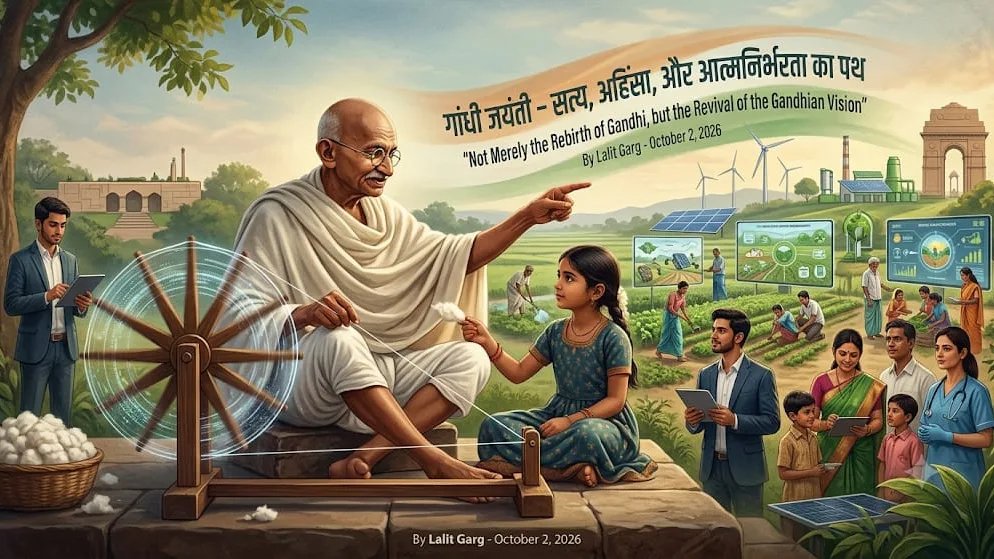
Remembering Mahatma Gandhi is not merely an act of paying tribute to a great figure of the past; it is also an opportunity to reflect on the direction of our present and the shape of our future. Gandhi does not belong to any particular era, political party, or ideology. He represents a philosophy of life rooted in truth, non-violence, self-discipline, self-reliance, service, swadeshi, village development, social harmony, and human dignity. Therefore, what we need today is not merely the rebirth of Gandhi, but the revival of the Gandhian vision. The more we search for Gandhi only in history, the more distant he appears as a figure of the past; but when we connect his ideas with the questions confronting the present, he becomes a guide for the future. Mahatma Gandhi emerged as one of the most powerful, influential and consequential leaders of the twentieth century. Revered as Bapu and popularly regarded as the Father of the Nation, he was a profoundly creative personality who, through the strength of his principles, helped lead India to freedom and sought to establish ethical and humane values in public life. The principles articulated and lived by him remain among the most powerful resources for addressing many of the challenges confronting the world today. Yet, ironically, we repeatedly put Gandhi in the dock and leave no opportunity to diminish his image. A mindset capable of firing a bullet at Gandhi should hardly surprise us when it resorts to abuse and vilification. But Gandhi is perhaps the only Indian statesman whose stature cannot be destroyed either by bullets or by insults.
India today is moving forward with the resolve to build a ‘New India’ and a ‘Developed India’. In this journey, Gandhi needs to be understood in a contemporary context. Gandhi’s idea of swadeshi was never confined to the spinning wheel; at its core was the principle of self-reliance. Prime Minister Narendra Modi, while remembering Gandhi on his death anniversary on January 30, 2026, also described swadeshi as a foundational pillar of the resolve for a developed and self-reliant India, recalling Gandhi’s emphasis on a sense of duty. Today, when India speaks of local production, self-reliance, innovation, digital capabilities and entrepreneurship, Gandhi’s ideal of self-reliance acquires a new economic and social meaning. For Gandhi, development did not simply mean an increase in production and prosperity. The ultimate objective of development was the human being. In his vision, concern for the weakest person was the true test of development. Today, the idea of ensuring access to opportunities and facilities for the last person can likewise be understood in the context of inclusive human development. Gandhi’s concept of Antyodaya was not the name of a government scheme; it was an ethical benchmark for development—one that places the person who stands at the margins at the very centre of our concern.
One of Gandhi’s greatest strengths was that he never regarded politics merely as a means of acquiring power. For him, the moral foundation of politics was service. Today, democracy needs to be understood not merely through elections and institutions, but also through dialogue, participation, accountability and public trust. Prime Minister Modi has, on various international platforms, highlighted India’s democratic traditions and its legacy of dialogue and participation. At the 2023 G20 Summit, he referred to India’s ancient traditions of assemblies and collective decision-making. This perspective resonates with Gandhi’s understanding of politics, in which people were not merely subjects of governance but active participants in nation-building. Gandhian thought also finds contemporary relevance in India’s foreign policy and its expanding global role. The theme of India’s G20 Presidency in 2023—‘One Earth, One Family, One Future’—was linked by Prime Minister Modi with the civilizational ethos of Vasudhaiva Kutumbakam, the belief that the world is one family, and with the need for cooperation in addressing global challenges. The visit of G20 leaders to Rajghat in New Delhi to pay homage to Gandhi was symbolically significant as well. On that occasion, Gandhi’s ideals of peace, service, compassion and non-violence were associated with the vision of a harmonious and inclusive global future.
Indeed, the world needs Gandhi’s life-values more urgently today than ever before. Religious extremism is increasing. In some places, violence and hatred are perpetrated in the name of jihad; elsewhere, riots, violence against women and children, and other forms of brutality continue to scar societies. Poison is being injected into social relations in the name of religion and sectarian identity. An arms race continues across the world, while terrorism has become a persistent threat to human life and security. In such circumstances, Gandhi is remembered with renewed urgency. Spreading the values he embodied can contribute to the pursuit of peace in the world. Here, Gandhi’s relevance acquires another profound dimension. The world today is passing through the challenges of war, terrorism, religious extremism, economic inequality, the climate crisis and growing distrust. Technology has enormously increased human power, but the question remains: Has it increased our humanity to the same extent? From artificial intelligence to nuclear weapons, humanity has acquired unprecedented power. But when power is not accompanied by restraint, compassion and ethical responsibility, it can become an instrument of destruction. Gandhi’s message is therefore even more significant today because he never separated the purity of means from the nobility of ends.
To confine Gandhi to any one political camp is to diminish the vastness of his personality and legacy. To reduce him merely to the Congress, the freedom movement, khadi, or a particular political interpretation is to do injustice to his universal stature. Gandhi emerged from the civilizational consciousness of India and became part of the moral consciousness of humanity. He is not confined by national boundaries. He belongs to the past, but he does not belong only to the past. He belongs to the present—and he has something to offer to every tomorrow. As India expands its role on the world stage, Gandhian philosophy can become an important source of its moral capital. Economic strength can make India influential, technological strength can make it capable, and strategic strength can make it secure; but moral strength can make India trusted and respected. Being a Vishwaguru should not mean establishing dominance over the world; it should mean presenting before humanity values from which the world can benefit. Gandhi represents one of India’s greatest possibilities for such moral leadership. The presentation of India’s spiritual traditions, democratic values and the ideal of Vasudhaiva Kutumbakam on international platforms can be viewed in this wider context.
The true achievement of a New India will not be measured merely by how large an economic power India becomes. The greater achievement will be determined by how humane, inclusive, compassionate and sustainable its development journey becomes. Roads, industries, the digital revolution, space missions, startups and economic growth are essential. But alongside them, truth, ethics, social harmony, cleanliness, environmental responsibility and sensitivity towards the vulnerable are equally necessary. This is precisely where Gandhi continues to stand alongside the development journey of modern India. Perhaps the greatest evidence of Gandhi’s enduring relevance is that the more attempts have been made to erase him, the more universal his presence has become. Today, Gandhi is not merely an Indian icon; he is part of the world’s moral discourse. In a world filled with violence, non-violence; amid divisions, dialogue; amid consumerism, restraint; amid centralization, decentralization; amid despair, truth; and amid power-centred politics, service—these are the Gandhian principles that the civilization of the future will continue to need.
Therefore, on this Gandhi Jayanti, we should not merely place flowers before Gandhi’s statue. We must ask ourselves how many of Gandhi’s values remain alive in our personal lives, society, politics, economy and worldview. Gandhi cannot be reborn as an individual. His true rebirth will occur only when truth once again becomes an act of courage, non-violence once again becomes a source of strength, swadeshi once again becomes an expression of self-confidence, service once again becomes the ethos of politics, and humanity once again becomes the centre of development. If the New India aspires to become a Developed India, and if India seeks to play a role of moral leadership in the world, it must harmonise modernity with spirituality, science with wisdom, power with peace, and development with compassion. Gandhi remains one of the most profound Indian symbols of this balance. We must take Gandhi out of the picture frame of the past and transform him into a vision for the future. That will be the truest tribute to Gandhi. And that will also define an India that seeks not merely to be developed, but to be compassionate, peaceful, ethical and a guiding force for the welfare of humanity.