— Lalit Gargg —
The beauty of Indian democracy lies in the fact that no government is permanent and no opposition remains in opposition forever. After a prolonged period in power, public fatigue with a government is natural. But there is a fundamental difference between public dissatisfaction and a desire for political change. Voters may question a government’s performance, but mere anger does not automatically make them accept an alternative that lacks a clear vision, credible leadership and a workable roadmap for the country’s future. This is the central question confronting the Indian opposition today: Is it merely dissatisfied with the government, or does it have a credible and better alternative to offer the people?
Rahul Gandhi has repeatedly questioned why the expected anti-incumbency against the Modi government is not becoming visible. He has alleged irregularities in the electoral process and raised the issue of “vote theft,” arguing that the genuine will of the people is not being properly reflected. The evidence and claims presented in support of these allegations remain subjects of political and legal debate, and it would be premature to treat them as conclusively established facts. Nevertheless, every question concerning electoral processes, voter lists and the transparency of the Election Commission deserves an impartial and factual response in the larger interest of democracy.
In this context, the controversy surrounding the Special Intensive Revision (SIR) of electoral rolls has assumed considerable importance. The Election Commission has been providing voter services and electoral rolls related to SIR-2026 while asserting its position as an independent constitutional authority. The opposition, on the other hand, has raised serious questions about the process and the functioning of Chief Election Commissioner Gyanesh Kumar. The matter has also reached the Supreme Court. Its final outcome must emerge through constitutional and judicial processes rather than political slogans. This is where the real test of the opposition begins.
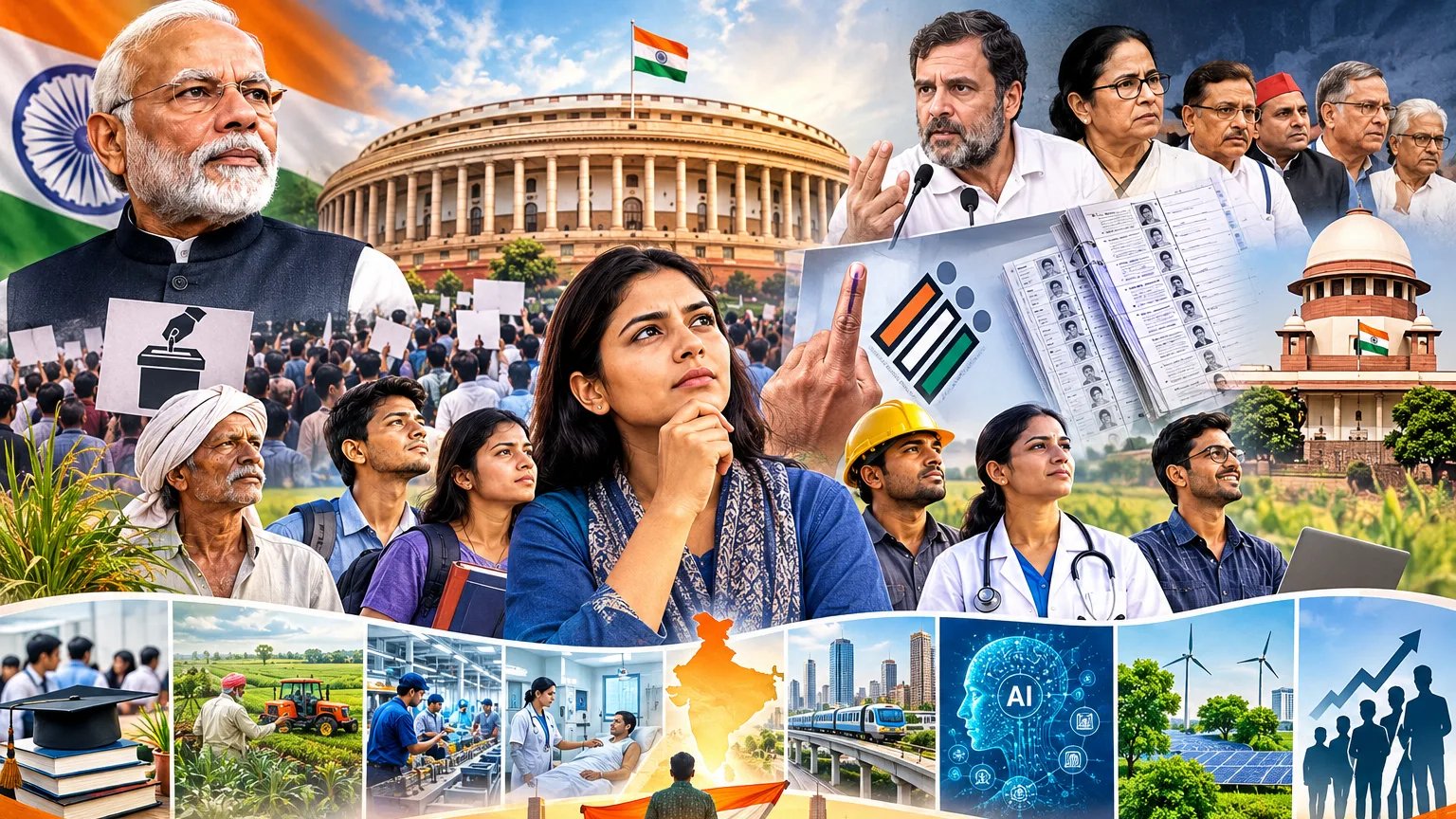
Opposing the Election Commission is a legitimate democratic right. If the name of an eligible citizen is wrongly deleted from the electoral roll, it must be challenged. If any official violates the rules, there should be an inquiry. But democracy cannot be protected merely by protesting against an institution. The opposition must also tell the people what it will do if given power—how it will improve education, employment, agriculture, healthcare, industry, urban life, law and order and governance. This is where the political discourse around “vote theft” encounters the everyday concerns of ordinary citizens.
Indian families are worried about the rising cost of education. The employment landscape is changing rapidly, while artificial intelligence and emerging technologies are making many traditional skills less relevant. Young people increasingly want to know how the next government will make competitive examinations credible, prevent paper leaks, improve school education and prepare millions of youths for the technology-driven economy. The farmer’s concerns are equally complex. His problems cannot be reduced merely to MSP or political protests. At harvest time, crop prices often fall sharply, while a few months later the same onions, tomatoes and other vegetables become expensive for consumers. The real solution lies in building an efficient agricultural ecosystem involving storage, cold chains, food processing, modern agricultural markets and value addition. If the opposition rejects existing policies, it must also explain what practical agricultural framework it proposes instead.
The employment challenge is even greater. India’s young population must be connected with manufacturing, services, research, innovation and emerging technologies. Investment requires stable laws, effective law and order, transparent administration and a trustworthy business environment. Political attacks on large industrialists or slogans about wealth redistribution cannot, by themselves, create jobs. If the opposition talks about redistribution of wealth or social justice, it must also explain how wealth, investment and opportunities will actually be created. The slogan of “proportionate share according to population” has brought the issue of social representation into national debate. But contemporary social justice requires more than representation. It requires capacity building. Children from backward communities, Dalits, tribals and economically weaker sections need quality education, healthcare, skills and equal opportunities. Merely counting communities is not enough; the ultimate objective must be to transform the lives of the people represented by those numbers.
Against this backdrop, the role of Mamata Banerjee has also become significant. Her emphasis on expanding the opposition’s reach and strengthening unity reflects an important political reality. The biggest challenge before the INDIA alliance is not merely confronting the BJP; it is overcoming mutual distrust within its own ranks. Seat-sharing, regional dominance, leadership questions and the fact that several alliance partners fight one another in different states make national unity difficult. The decision of the Aam Aadmi Party to pursue its own course and stay away from the proposed march to the Election Commission is another indication of these internal contradictions. When the Congress, Trinamool Congress, Samajwadi Party, Left parties, RJD, AAP and other regional parties follow different political strategies in different states, the public naturally wants to know: What is their common national programme? What will they do together if they come to power? What is their economic vision? What is their employment strategy? How will they strengthen national security, education, healthcare and infrastructure? These questions cannot be answered merely through opposition to Narendra Modi.
The same principle applies to the Election Commission controversy. The INDIA alliance’s protest programmes and demand for the resignation of Chief Election Commissioner Gyanesh Kumar can bring important constitutional issues into public debate. But if the entire campaign becomes confined to demanding the resignation of one individual, it will not resolve the larger question of public confidence in electoral institutions. The opposition must explain what institutional reforms it proposes regarding the appointment of Election Commissioners, electoral rolls, EVMs and VVPATs, political funding and electoral transparency. Questioning an institution is a democratic right; presenting a credible plan to strengthen it is a political responsibility. The larger crisis before the opposition is therefore not a shortage of issues. India has no shortage of issues—unemployment, education, agriculture, healthcare costs, inflation, pollution, urban infrastructure, technological disruption and global economic competition are all genuine concerns. The problem is the inability to convert these concerns into a convincing political alternative.
Political discourse repeatedly gets reduced to Modi versus who, Rahul versus Modi, EVM versus ballot paper and Election Commission versus opposition. But the Indian voter is increasingly looking beyond these binary battles. Even when voters become dissatisfied with a government, they carefully examine the alternative before them. They do not willingly abandon familiar ground merely to enter an uncertain political future. They want an opposition that not only exposes the government’s shortcomings but also demonstrates its own capabilities; an opposition that does not merely criticise governance but presents an alternative model of governance; an opposition that questions electoral institutions while also committing itself to electoral transparency; an opposition that speaks of social justice while presenting a concrete pathway to education and opportunity; and an opposition that questions industrialists while clearly explaining how it will attract investment and generate employment. In a democracy, the accountability of the government is essential—but the accountability of the opposition is equally important.
Public dissatisfaction with a government is a natural feature of democracy. But converting that dissatisfaction into a political transition requires a credible, competent and convincing alternative. The greatest challenge before the INDIA alliance is therefore larger than simply defeating the BJP or Narendra Modi. It must convince the people that it possesses a clear, concrete and implementable vision for India’s next decade. If the opposition succeeds in creating that confidence, the Election Commission issue can evolve into a meaningful debate on democratic reform, Mamata Banerjee’s role can acquire greater significance, and Rahul Gandhi’s questions can become part of a broader and more constructive national discourse. Ultimately, people are not merely looking for a government to oppose. They are looking for a government they can trust. The opposition’s real test is not how loudly it criticises those in power, but how convincingly it demonstrates that it is ready to exercise power.