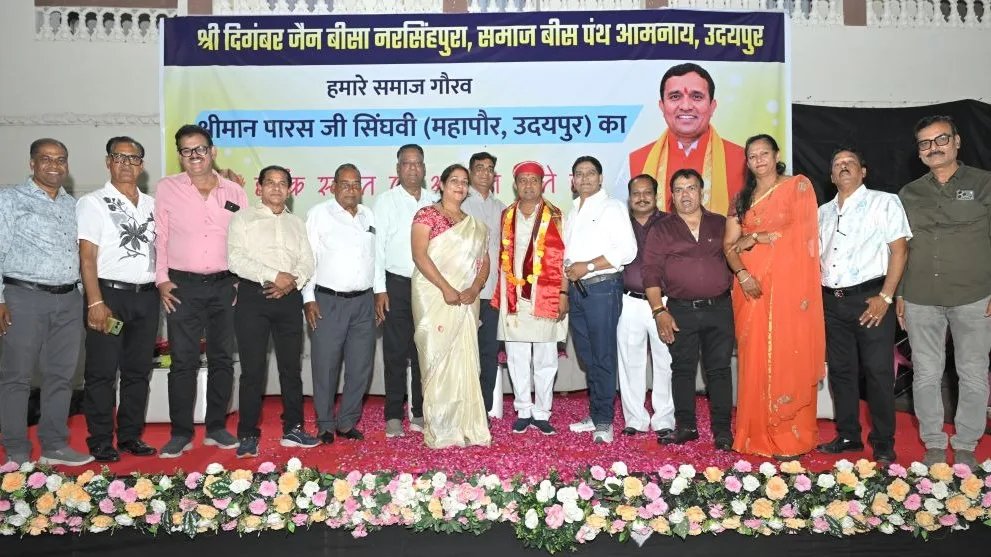
Udaipur: Emphasising the importance of penance, sacrifice and self-discipline in Jain philosophy, Udaipur Municipal Corporation Mayor Paras Singhvi said that true self-welfare can be achieved through tapasya and spiritual practice. The Tapasvi Samman Samaroh 2026, organised by the Shri Digambar Jain Bisa Narsinghpura Samaj (Bees Panth Aamnaya), Udaipur, was held at Narsinghpura Nohra on the occasion of the sacred Paryushan Mahaparva. The ceremony honoured 20 members of the Jain community who observed rigorous fasting and undertook various forms of penance during Paryushan. The honoured tapasvis were felicitated with tilak, garlands, ceremonial stoles and mementoes in recognition of their spiritual discipline and dedication. The programme was attended by Udaipur Municipal Corporation Mayor Paras Singhvi as the chief guest, while Gajpal Singh Rathore, BJP City District President, was the guest of honour. Samaj President Rishabh Jasingot, General Secretary Anil Mehta, Treasurer Ajit Manawat and other members of the executive committee welcomed the guests and honoured them with shawls, stoles and commemorative symbols. ‘Tapasya Inspires Spiritual Consciousness’ Addressing the gathering, Mayor Paras Singhvi said that tapasya, renunciation and self-restraint hold a supreme place in Jain philosophy. He appreciated the determination displayed by community members, particularly the youth and women, in undertaking such rigorous spiritual practices. “In today’s materialistic environment, such dedication to spiritual discipline is not only admirable but also inspirational for society,” he said. He added that penance contributes not only to inner purification, but also helps spread an atmosphere of spiritual awareness across the community. Guest of honour Gajpal Singh Rathore said that Jain culture represents an extraordinary tradition of renunciation and self-control. Through rigorous spiritual practice, devotees strive to exercise control over their senses and strengthen their inner resolve. He said that honouring those who undertake tapasya is a way of recognising the community’s deep faith in its religious and spiritual traditions. Such programmes, he added, also strengthen the spirit of unity and collective participation within society. 20 Tapasvis Felicitated The ceremony recognised devotees who completed different durations of fasting during Paryushan. Those observing 16-day fasts included Priya Salawat and Mayank Bhorawat. Those completing 10-day fasts included Shankar Devi Gamadia, Dr. Reena Mehta, Sudarshan Kunawat, Apurna Bhorawat, Meenal Varadawat, Ayushman Sipriya, Vandana Navadia, Shashi Ratodia and Vijay Mehta. Those who completed five-day fasts included Arvind Bhorawat, Rekha Bhorawat, Asha Navadia, Pratham Kunawat, Suraj Kunawat, Kavish Nathut, Pari Damawat, Divyanshi Bhorawat, Preeti Lolawat and Hardvi Mehta. A large number of community members attended the ceremony. Samaj President Rishabh Jasingot, General Secretary Anil Mehta, Treasurer Ajit Manawat, along with Laxmilal, Shekhar Kunawat, Rajesh Gamadia, Vimal Nathut, Kamlesh Lolawat, Vinita Hinsawat and other office-bearers and executive committee members, were present. The programme was conducted by Anil Mehta. Make the report more conciseUse a stronger newspaper lead
Tapasya and Spiritual Discipline Lead to Self-Welfare: Paras Singhvi
20 Jain Ascetics Honoured at Tapasvi Samman Samaroh 2026 in Udaipur
मुख्य बिंदु
- Udaipur: Emphasising the importance of penance, sacrifice and self-discipline in Jain philosophy, Udaipur Municipal Corporation Mayor Paras Singhvi said that true self-welfare can be achieved through tapasya and spiritual practice.
- The Tapasvi Samman Samaroh 2026, organised by the Shri Digambar Jain Bisa Narsinghpura Samaj (Bees Panth Aamnaya), Udaipur, was held at Narsinghpura Nohra on the occasion of the sacred Paryushan Mahaparva.
- The ceremony honoured 20 members of the Jain community who observed rigorous fasting and undertook various forms of penance during Paryushan.
- The honoured tapasvis were felicitated with tilak, garlands, ceremonial stoles and mementoes in recognition of their spiritual discipline and dedication.