
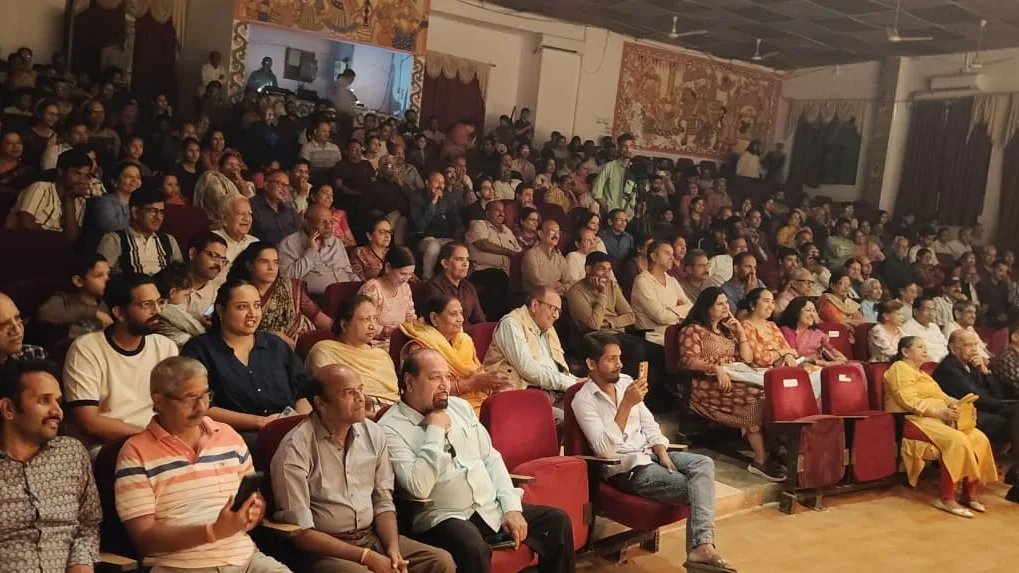
*An outstanding adaptation of Krishna Chander’s iconic satire brings bureaucratic absurdities, human helplessness and the power of theatre vividly to life in Udaipur* Some literary works find their true brilliance when they move from the printed page to the theatre stage. I experienced this beautifully while watching the recently staged play Jamun Ka Ped (The Jamun Tree), based on the celebrated satirical story by the legendary Urdu writer, late Krishna Chander. Jaipur-based Neeraj Goswami deserves special appreciation for transforming this literary satire into an engaging theatrical production. With his understanding of theatre and experience as a performer, he has shaped the original story into a compelling stage adaptation that wins both laughter and admiration. The production acquired its full satirical flavour under the direction of renowned theatre director Ishwardutt Mathur. One of the most striking aspects of the production was its ensemble of 15 actors, many of them seasoned and senior theatre artistes. Their years of experience, natural expressions and effortless performances created a remarkable impact. Playing several characters between them, the team kept the audience engrossed for nearly 80 minutes. It was also a reminder that the spirit of theatre is often sustained by passionate amateur performers, whose commitment and love for the stage deserve greater recognition. The performance was presented under Rangshala, the monthly theatre programme organised by the West Zone Cultural Centre, Udaipur, functioning under the Ministry of Culture, Government of India. The Darpan Auditorium at Shilpgram was packed with theatre lovers, and waves of laughter echoed throughout the evening. ### A Satire on a System That Forgets the Human Being At the heart of Jamun Ka Ped is the story of an ordinary man trapped beneath a fallen jamun tree within the Secretariat premises. What should have been an urgent humanitarian rescue operation turns into a spectacle of administrative confusion. Instead of taking responsibility and rescuing the man, government officials become occupied with passing the blame from one department to another. The bureaucracy gets entangled in files, procedures and official formalities, while the man continues to suffer beneath the tree. Even the public and opposition politicians attempt to use the incident for their own interests. Through this seemingly absurd situation, the play exposes the tragic gap between administrative machinery and human sensitivity. The audience laughs at the unfolding comedy, but beneath the laughter lies an uncomfortable question: What happens when a system becomes more concerned about paperwork than human life?
### Dialogue That Leaves a Lasting Impression The play's sharp, witty and fearless dialogues were among its greatest strengths. Several lines continued to resonate long after the curtains came down. Among the memorable exchanges were: - "Not everyone who breathes is necessarily alive." - "You are clerks; you cannot even move a file. How will you move a tree?"
- "Are you Secretariat employees that you sleep during the day?"
- "A man is trapped here. It is not the price of petrol that will keep rising!"
- "The word 'man' may appear in the Sahitya Akademi's vocabulary, but the institution has nothing to do with the man himself." - "The Akademi's job is to keep people buried. How did this tree manage to do it?"
These lines drew spontaneous laughter, but their deeper meaning exposed the absurdities of officialdom, institutional indifference and a system that often loses sight of the very people it is meant to serve. ### A Team Performance Worth Applauding Director Ishwardutt Mathur demonstrated considerable theatrical skill in shaping the pace, humour and dramatic rhythm of the production. Renowned poet and lyricist Lokesh Kumar Singh wrote the songs and also delivered a powerful performance in the role of the politician. Music and vocals were handled by Sardar Gurminder Singh Puri (Romi), adding another engaging dimension to the presentation. Every actor contributed meaningfully to the ensemble. Manoj Swami, Vedant Sharma, Aneesh Ansari, Yadvendra Yad, Dhanraj Dadhich, Rahul, Mohinuddin Khan, Rajendra Sharma (Raju), Ashok Maheshwari, Alok Chaturvedi and Anurag Singh, along with Neeraj Goswami and Ishwardutt Mathur, brought their respective characters to life with convincing and entertaining performances. Lighting was handled by Siddhant Bhatnagar, while Mukul Audichya managed the stage arrangements. ### Theatre That Entertains and Awakens What made Jamun Ka Ped memorable was not merely its humour or the quality of acting. It was the way a simple story transformed into a powerful commentary on bureaucracy, accountability and the value of human life. The production demonstrated that meaningful theatre does not always require elaborate sets or commercial glamour. A strong script, sensitive direction, experienced performers and a genuine passion for the art form can create an unforgettable experience. Congratulations are due to Jaipur's Rangshilp Natya Samiti and the entire team of the West Zone Cultural Centre, Udaipur, for bringing such a thought-provoking production to the audience. Jamun Ka Ped was more than an evening of entertainment. It was a theatrical experience that made us laugh at the system, reflect on its contradictions and leave the auditorium with questions that continue to linger. By Vilas Janve\ Culture Enthusiast