
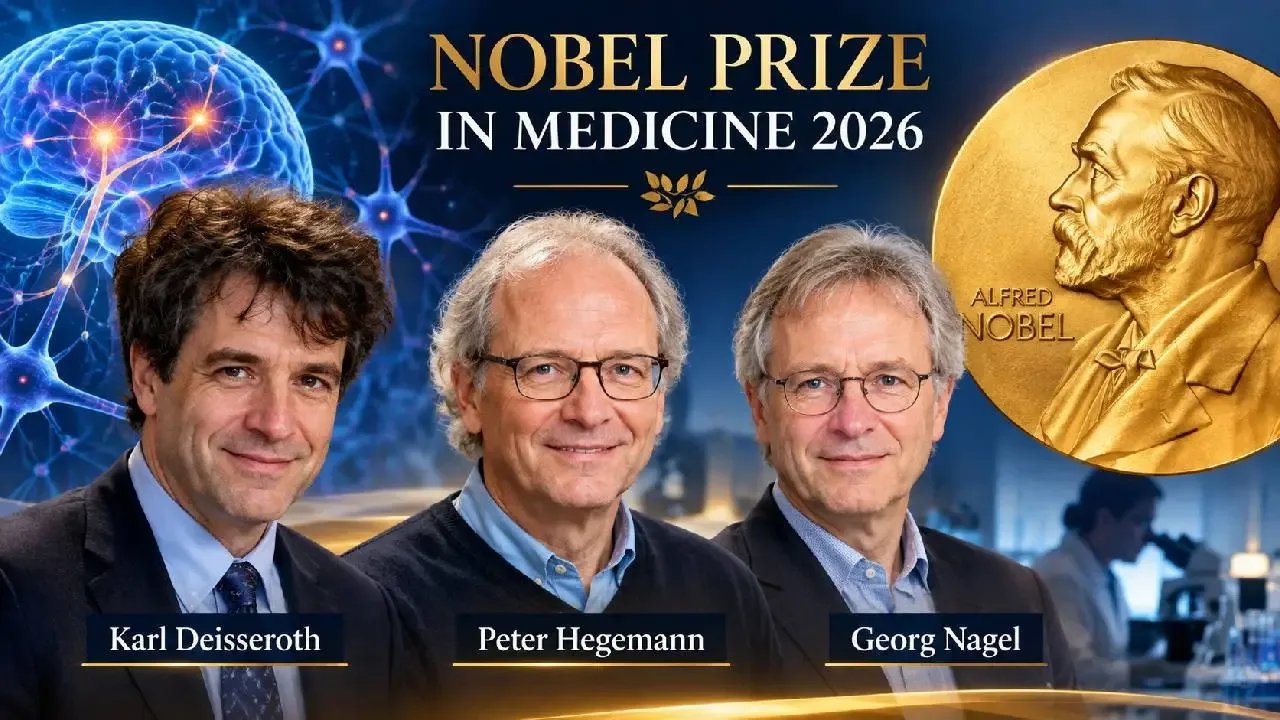
The journey of human civilization is, in many ways, a journey from darkness towards light. At times, human beings have looked towards the skies to understand the mysteries of nature; at others, they have ventured into the depths of the earth to discover the secrets of life, and they have also turned inward to explore the extraordinary powers hidden within the human body. Every significant scientific discovery has opened a new horizon before humanity. Yet, among all these mysteries, the human brain remains one of the greatest enigmas. The very brain that enabled humanity to cross mighty mountains, explore the depths of oceans, reach outer space and develop artificial intelligence is still not fully understood. How thoughts originate, how memories are formed, how emotions influence our behaviour, and how mental suffering can transform a person's life—these questions have long challenged scientists. Against this backdrop, research into controlling nerve cells through light represents far more than a scientific achievement. It offers new hope for understanding the human mind and reducing human suffering. The research associated with Karl Deisseroth, Peter Hegemann and Georg Nagel, as referred to in connection with the 2026 Nobel Prize in Medicine, exemplifies this remarkable scientific quest. The development of optogenetics has provided scientists with a powerful method to study brain activity by enabling them to activate or inhibit specific nerve cells using light.
What makes this achievement particularly remarkable is that it did not begin with experiments on the human brain in some sophisticated laboratory. Its origins can be traced to attempts to understand light-sensitive proteins found in a tiny alga. A secret hidden within a microscopic organism ultimately opened new possibilities for studying the human brain. It reminds us that nothing in nature is truly insignificant. Sometimes, solutions to humanity's greatest challenges are hidden in the smallest components of life. To understand the essence of this discovery, we must first understand how the brain works. Our brains contain an enormous network of nerve cells, or neurons, which communicate with one another through electrical and chemical signals. These interactions influence memory, sensation, fear, happiness, decision-making and behaviour. Earlier, scientists could observe which regions of the brain became active during a particular activity, but merely observing activity did not necessarily establish whether a particular group of neurons was actually responsible for that activity. The ability to selectively control neurons through light has helped bridge this gap. Scientists can now investigate with much greater precision what happens when a particular group of neurons is activated or when its activity is suppressed, and how such changes affect behaviour or physiological responses. Brain research has therefore moved beyond merely observing activity towards understanding the relationship between cause and effect. At the same time, it is equally important to distinguish scientific promise from established medical achievement. The safe application of such techniques in the human brain still involves significant scientific, medical and ethical challenges. Similarly, this research may have important implications for understanding the relationship between the brain and artificial intelligence, but every potential application should not be presented as an established accomplishment. True scientific thinking keeps hope alive while remaining firmly committed to facts and evidence.
This discovery can also be viewed in the broader context of scientific breakthroughs that have transformed human life. Vaccines opened new avenues for preventing infectious diseases; antibiotics made it possible to treat numerous life-threatening infections; and modern surgery has saved countless lives. The significance of such discoveries lies not merely in their scientific novelty but in their far-reaching social impact. At the same time, some scientific breakthroughs took decades to move from laboratories into everyday medical practice. Research on the brain is part of this same long journey. Its true value will become evident when the knowledge it generates leads to safe treatments, accessible healthcare and tangible improvements in the lives of patients. The greatness of science lies not merely in unlocking a mystery, but in using that knowledge for the welfare of humanity. In this context, the significance of the Nobel Prize also deserves to be understood in a broader sense. It is not merely a celebration of an individual scientist's achievement; it is also a recognition of years of perseverance, curiosity, failures, experimentation and patience without which major discoveries would rarely be possible.
This discovery also raises profound ethical and philosophical questions. The human brain is not merely the centre of thoughts and responses; it is deeply connected with our identity, experiences and sense of self. If scientists can activate or inhibit specific groups of neurons and thereby influence behaviour, an important question arises: what should be the limits of our ability to control brain activity? The development of such technologies for treating disease and alleviating human suffering is undoubtedly welcome. But their use must necessarily protect human dignity, individual freedom, privacy and informed consent. The scientific ability to understand a person's thoughts and emotions cannot be allowed to become a justification for claiming the right to control the human mind. The greater the power science acquires, the greater the responsibility that must accompany it. For a country like India, the message of such research is particularly significant. Providing quality healthcare to a vast population, overcoming social hesitation surrounding mental health and connecting scientific research with the needs of ordinary people remain major challenges. Mental illnesses must not be treated as signs of weakness or sources of social stigma. They need to be approached with sensitivity, scientific understanding and appropriate medical care. New scientific discoveries will become truly meaningful only when their benefits are not restricted to affluent sections of society or developed countries. Treatments emerging from research must also be safe, accessible and affordable. The real democratization of knowledge will occur only when even the most vulnerable sections of society can benefit from scientific progress.
Ultimately, the quest to understand the mysteries of the brain gives us much more than new knowledge about the biological structure of the human mind. It also encourages us to reflect on the very purpose of civilization. The highest use of the intelligence with which humanity has sought to understand nature should be to understand and alleviate the suffering of others. The true meaning of light is not merely the removal of darkness; it is also the transformation of the way we see life. The journey from a scientific possibility hidden within a tiny alga to the complex functioning of the human brain teaches us humility, patience and curiosity. It reminds us that the mysteries of nature are limitless and that human knowledge remains incomplete. Therefore, every new scientific achievement should not be regarded as the final answer, but as an opportunity to ask better questions and seek more humane solutions. The ultimate success of any discovery will be measured not merely by what it achieves within the laboratory, but by whether it can bring relief to a suffering person, hope to someone living in despair and greater sensitivity to society. That is the true human test of science—and the new vision that the world needs today.