
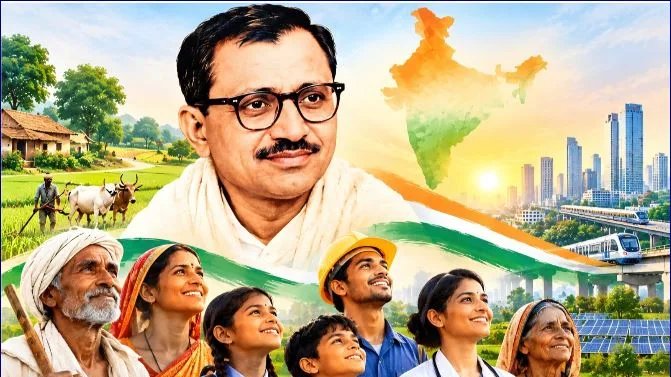
— By Lalit Garg
India’s development journey has entered a phase in which new chapters are being written in economic strength, technological capability, digital transformation and global influence. India recorded real GDP growth of 7.8 percent in the first quarter of 2026–27 and is being seen as one of the fastest-growing major economies in the world. Yet the true prosperity of a nation cannot be measured merely by its GDP, high-rise buildings, modern highways or position in global rankings. The ultimate test of development is how far its benefits reach the person standing at the very end of the queue. This is where the philosophy of Antyodaya acquires profound relevance. Every year, 25 September is observed as Antyodaya Diwas in India. The day marks the birth anniversary of Pandit Deendayal Upadhyaya, and the Government of India declared 25 September as Antyodaya Diwas in 2014. The Deen Dayal Upadhyaya Grameen Kaushalya Yojana was also launched around this occasion with the objective of connecting rural poor youth with skills and employment opportunities. Therefore, Antyodaya Diwas is not merely an occasion to remember a great thinker and nation-builder; it is an opportunity to reconsider the direction, priorities and human purpose of development.
The word Antyodaya combines two concepts—Antya, meaning the last or the person at the farthest end, and Udaya, meaning rise or upliftment. But Antyodaya does not simply mean providing assistance to the poor. Its broader meaning is the creation of a social and economic order in which no individual is deprived of opportunity, no family is left behind for want of basic necessities, and the fruits of development reach the last mile. In Pandit Deendayal Upadhyaya’s philosophy of Integral Humanism, a human being is not merely an economic unit or an instrument of production. The harmonious development of the body, mind, intellect and soul is essential. This makes Antyodaya much more than a welfare concept; it transforms it into a comprehensive philosophy of human-centred development. Today, the question is not whether India is developing. The more important question is: How quickly, how deeply and how inclusively are the benefits of this development reaching the last person? This is precisely the question that makes Antyodaya Diwas particularly significant in 2026.
India has set its sights on becoming a Viksit Bharat by 2047. This vision cannot be limited to increasing the size of the economy. A developed India must also mean developed villages, empowered citizens, quality education, accessible healthcare, dignified employment, social security, digital access, entrepreneurship and equal opportunities for advancement. Inclusive human development must therefore remain at the heart of the Viksit Bharat vision. The faster the economy grows, the greater the responsibility to ensure that no one is left behind in the race for progress. The more powerful technology becomes, the more urgent it is to bridge the digital divide. The more employment opportunities emerge, the greater the need to equip poor and rural youth with the skills required to participate in the new economy. India’s vast informal workforce also reminds policymakers that technology alone cannot automatically produce inclusive transformation. Access to opportunities, social protection and essential services must accompany technological progress.
From this perspective, the contemporary meaning of Antyodaya should be a transition from assistance to empowerment. The poor should receive not merely subsidies, but opportunities. Farmers need not only relief, but higher productivity, better technology and access to markets. Workers need not merely employment, but skills, dignity and social security. Women need not only welfare schemes, but education, property rights, entrepreneurship and a meaningful role in decision-making. Rural youth should not be compelled to migrate to cities simply in search of livelihoods; villages and small towns should increasingly become centres of skills, digital access, innovation and entrepreneurship. This is the modern expression of Antyodaya—to transform the individual from a beneficiary into a participant and partner in development.
The Deen Dayal Antyodaya approach, including initiatives aimed at strengthening livelihoods and skill development among rural and urban poor, reflected the importance of creating sustainable opportunities rather than relying solely on welfare. Today, that vision needs to become even broader and more integrated. Education, healthcare, employment, skills, housing, nutrition, financial inclusion, digital connectivity and social security must not function as isolated interventions. They need to converge around the dignity and empowerment of the individual. India’s expanding economy brings with it an expanding responsibility. Official data indicate that real GDP growth was 7.7 percent in 2025–26 and 7.8 percent in the first quarter of 2026–27. The aspiration to make India the world’s third-largest economy has also become a prominent part of the country’s economic and public-policy discourse. Yet the journey towards becoming an economic powerhouse will acquire its fullest meaning only when the social foundations of that economic strength are equally robust.
The aspiration to become a Vishwaguru cannot be fulfilled merely by demonstrating intellectual or economic influence to the world. Its deeper test will lie in ensuring a dignified life for the last person within our own society. India’s civilisational consciousness has long carried ideals such as Sarve Bhavantu Sukhinah—may all be happy—and Vasudhaiva Kutumbakam—the world is one family. Antyodaya can be understood as a contemporary socio-economic expression of this humanistic tradition. It reminds us that national prosperity cannot mean the prosperity of a few; it must represent the advancement of society as a whole. The most meaningful way to keep Pandit Deendayal Upadhyaya’s memory alive is therefore not merely to garland his portrait or organise commemorative programmes, but to translate the human dimension of his thought into action. His life was associated with simplicity, organisational dedication, national service and ideological commitment. His philosophy of Antyodaya continues to challenge every generation with a fundamental question: Who is the ultimate beneficiary of our development, and has that person truly become part of the mainstream?
A developed India in 2047 will not be built by governments alone. It will require the collective participation of governments, communities, industry, voluntary organisations, educational institutions and citizens. Local entrepreneurship must flourish in villages, young people must receive relevant skills, the quality of education must improve, healthcare must reach the last mile, and government programmes must work in greater coordination. Digital public infrastructure and emerging technologies can accelerate this process. But technology must remain a means, not the final objective. The real objective is human empowerment. The greatest message of Antyodaya is that national progress must be viewed not only from the top downward, but also from the bottom upward. When the last village advances, India advances. When the last family becomes self-reliant, India becomes stronger. When the last child receives quality education, India’s future becomes stronger. When the last worker receives dignity and security, India’s development becomes more humane.
Antyodaya Diwas, therefore, should not remain merely a commemorative day observed on 25 September. It should become a moral benchmark for India’s development journey. The most enduring monument to Pandit Deendayal Upadhyaya would not be a building or a statue, but an India in which the last person does not feel excluded from the system, but sees himself or herself as a respected and equal participant in the nation’s progress.
The height of a developed India will be visible in its economic strength, technological advancement and global influence. But its true greatness will be measured by how far its progress travels and how many lives it transforms. Antyodaya is the human foundation of that journey. If India is to become prosperous, empowered, self-reliant and just by 2047, it must, at every milestone of its development, look back at the person standing at the very end—and ask whether he or she has risen with the nation. Because the rise of India will find its fullest meaning only when the last person rises.