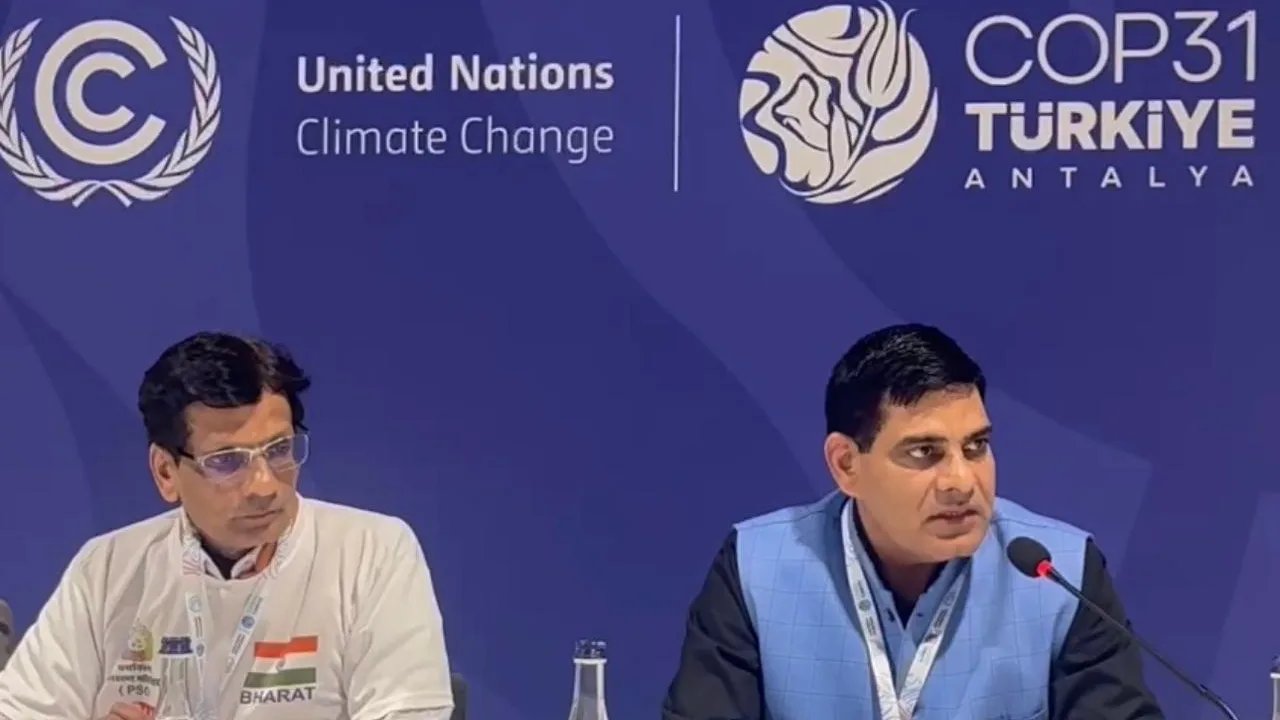
Antalya ( Turkiye) 21 November. The conclusion of the 31st Conference of the Parties to the United Nations Framework Convention on Climate Change (UNFCCC COP31) in Antalya, Türkiye, provides an opportunity to reflect on the future direction of global climate action. Among the important contributions to the climate dialogue were the constructive engagements and international dialogues organised by Team HARIT of Paryavaran Sanrakshan Gatividhi (PSG), in collaboration with partner organisations. These dialogues sought to bring India's ecological philosophy and community-based environmental initiatives into the global conversation, highlighting the interconnected roles of Citizen-Determined Contributions (CDCs), Mission LiFE, indian knowledge systems, HARIT GHAR and a lifestyle transformation rooted in harmony with nature. One of the key dialogues, titled “HARIT Pathways to Climate PEACE: Just Transition through Citizen-Determined Contributions (CDCs)”, explored how climate action could move beyond commitments made by governments towards voluntary commitments determined and practised by citizens themselves. The discussions brought together experts and representatives from academic institutions, civil society, spiritual organisations and youth-oriented institutions to explore a people-centred approach to climate action. The central proposition was that while national and international commitments are indispensable, their success ultimately depends on the participation of individuals, households, communities and institutions. India's experience through Mission LiFE and several grassroots initiatives of Paryavaran Sanrakshan Gatividhi demonstrates how environmental responsibility can become an integral part of everyday life. These discussions acquire particular relevance in the context of India's official position at COP31. India's COP31 position- Climate justice, equity and implementation: India's position at COP31, articulated through the Opening Statement by Shri Narendra Bhooshan, Secretary, Ministry of Environment, Forest and Climate Change, on 10 November 2026, and the National Statement delivered by Union Minister Shri Bhupender Yadav on 18 November 2026, reaffirmed the country's commitment to climate multilateralism, equity and the principle of Common but Differentiated Responsibilities and Respective Capabilities (CBDR-RC). India emphasised that climate action must recognise historical responsibilities and the different development circumstances and capabilities of nations. Developed countries must fulfil their climate-finance obligations, particularly under Article 9.1 of the Paris Agreement, which establishes their responsibility to provide financial resources to developing countries. For the Global South, climate action cannot be separated from the legitimate aspirations of development, poverty eradication, affordable energy, food and water security, health, education and decent livelihoods. A Just Transition must therefore be equitable, inclusive and sensitive to national circumstances. It must address adaptation needs, employment, social protection, technology transfer and capacity-building, rather than being confined to a narrow transition in energy sources. India also welcomed the COP31 Presidency's vision of a “COP of Implementation” based on Dialogue, Consensus and Action. Dialogue builds trust, consensus ensures collective ownership, and action translates commitments into tangible progress on the ground. This vision provides a valuable opportunity to connect international climate cooperation with national implementation and citizen participation. The HARIT approach seeks to complement this vision by adding a strong ecological and societal dimension: while governments must fulfil their national and international obligations, citizens and communities can voluntarily determine and undertake locally relevant environmental actions. Climate justice must ensure fairness among nations, Just Transition must protect people and livelihoods, and citizen participation must translate environmental responsibility into action on the ground. From NDCs to CDCs-From national commitments to citizen ownership: The Paris Agreement established Nationally Determined Contributions (NDCs) as the principal framework through which countries communicate their climate commitments. These commitments are essential, but their implementation requires participation across millions of households, institutions, villages, towns and communities. This calls for a complementary idea: "Citizen-Determined Contributions (CDCs)" . NDCs define what nations commit to do; CDCs invite citizens to determine what they themselves will do for Mother Earth. CDCs may be understood as voluntary, locally rooted and measurable environmental commitments made by individuals, households, communities, educational institutions, civil society organisations and local institutions. These commitments can include conserving water and energy, reducing waste, protecting biodiversity, restoring ecosystems, promoting responsible consumption and strengthening climate resilience. The purpose of CDCs is not to replace NDCs, dilute government responsibilities or absolve major polluters of their obligations. Nor should they become a mechanism for transferring the financial and institutional burden of climate action to vulnerable communities. They are proposed as a complementary, people-centred framework through which citizens can voluntarily contribute to national and global environmental objectives according to their capacities and local circumstances. The idea is particularly relevant to India's Mission LiFE and the many community-based environmental initiatives already underway in the country. The essential transition is from commitments made for citizens to commitments determined and practised by citizens. Mission LiFE -Making environmental responsibility a people's movement: India's "Mission LiFE—Lifestyle for Environment" provides a practical foundation for citizen-led climate action. It recognises that environmental protection cannot remain confined to government policies, infrastructure investments and technological interventions. It must become part of everyday choices and collective social behaviour. Saving water and electricity, reducing single-use plastics, segregating and reusing waste, choosing sustainable transport, avoiding food wastage, conserving biodiversity and adopting responsible consumption habits are simple but meaningful ways in which citizens can contribute to environmental protection. When these actions are adopted collectively by households, schools, colleges, institutions and communities, they can generate significant ecological benefits. The experience of Paryavaran Sanrakshan Gatividhi demonstrates how such participation can be organised through a range of practical initiatives. These initiatives are not merely awareness campaigns; they seek to convert awareness into participation, participation into measurable action, and individual action into a collective environmental movement. They offer meaningful examples of CDCs in practice. Paryavaran Sanrakshan Gatividhi -Translating awareness into citizen action: Paryavaran Sanrakshan Gatividhi has been working through educational institutions, youth organisations, social organisations, community networks and individual volunteers to promote environmental responsibility. Its initiatives demonstrate how citizen participation can be encouraged across different age groups and social settings. 1. National Environment Youth Parliament (NEYP): Empowering the next generation: The National Environment Youth Parliament (NEYP) provides a platform for young people from universities and educational institutions across the country to deliberate on environmental challenges, discuss policy issues and develop leadership for ecological protection. Through debates, discussions and parliamentary-style deliberations, students engage with subjects such as water conservation, forests, biodiversity, climate change, pollution and sustainable development. The initiative seeks to develop environmentally conscious citizens and future leaders who can contribute to policy dialogue as well as grassroots action. NEYP demonstrates that young people should not be treated merely as beneficiaries of environmental education. They must become active participants in shaping environmental priorities, influencing institutions and taking responsibility for implementation. In the context of CDCs, NEYP represents the dimension of "citizen determination through informed youth leadership" . 2. National Student Paryavaran Competition (NSPC)- Learning through participation: The National Student Paryavaran Competition (NSPC) seeks to engage students from school to Universitiy levels through environmental quizzes, awareness activities and action-based participation. Its editions have focused on environmental conservation, Sowing to Growing and HARIT—The Way of Life. Participants are encouraged not only to learn about environmental challenges but also to undertake practical actions such as planting trees, conserving water and segregating waste. By connecting environmental knowledge with practical activities, NSPC helps create a generation that understands the relationship between personal choices and ecological well-being. It demonstrates that environmental education becomes more effective when learning is accompanied by participation and measurable action. 3. EcoMitram App: Bringing environmental action into every household: The "EcoMitram App" , developed as a digital platform of Paryavaran Sanrakshan Gatividhi, provides an opportunity to connect individual and household-level environmental practices with a wider community movement. Citizens can use the platform to record their green habits, participate in environmental campaigns, undertake tree plantation and cleanliness activities, complete environmental quizzes, share their actions and track their contributions. Activities such as saving water, segregating household waste, planting saplings, reducing plastic use and adopting environmentally responsible practices can be recorded and shared. Educational institutions, NGOs and community groups can also mobilise participants and organise local initiatives. EcoMitram provides an important digital dimension to the CDC concept. It can help translate voluntary commitments into recorded actions, encourage community participation and make individual contributions more visible. The household becomes an important unit of climate action, and every citizen becomes a potential contributor to ecological conservation. 4. Ek Thali Ek Thaila -A people-led initiative at Prayagraj Mahakumbh: The “Ek Thali Ek Thaila” campaign during the Prayagraj Mahakumbh in January 2025 demonstrated how a large religious and cultural gathering can become an opportunity for environmental responsibility. The initiative promoted the use of reusable steel plates and cloth bags to reduce dependence on disposable materials and single-use plastics. According to the campaign's reported figures, approximately 14 lakh steel plates and 13 lakh cloth bags were collected. These were donated by the citizens of the country .It was in s way zero budget programme. The campaign illustrates how environmental protection can be integrated with India's cultural and spiritual traditions. It also demonstrates that mass participation, collective discipline and practical alternatives can reduce the environmental footprint of large public gatherings. The initiative carries a wider message: environmental responsibility is not separate from culture and faith; it can become an expression of both. In the language of CDCs, every person choosing a reusable plate or cloth bag becomes a participant in reducing waste and protecting the environment. 5. Swachh Sagar, Surakshit Sagar- Citizens as custodians of the oceans: The "Swachh Sagar, Surakshit Sagar" initiative and associated coastal-cleaning campaigns highlight the importance of citizen participation in protecting marine ecosystems. Through the involvement of volunteers, educational institutions, social organisations and coastal communities, these campaigns have encouraged people to take responsibility for cleaning beaches, reducing marine litter and preventing plastic pollution. Paryavaran Sanrakshan Gatividhi has participated in large-scale coastal environmental mobilisation, including the nationwide coastal-cleanup effort recorded in its campaign history. Such initiatives demonstrate that the responsibility for protecting oceans and coastlines does not rest only with government agencies. Citizens, communities, students and local organisations can contribute directly through voluntary action. They also connect local behaviour—particularly plastic consumption and waste disposal—with the health of marine ecosystems and the global environment. 6.Bal Sansad – National Children’s Environment Parliament-Nurturing Ecological Leadership from Childhood: The Bal Sansad (National Children’s Environment Parliament 2026), organised by Paryavaran Sanrakshan Gatividhi provided a national platform for school students to deliberate on environmental challenges and sustainable development. The initiative was conducted under the theme “Sowing Today to Growing Tomorrow.” More than 15,000 students from 152 schools across 15 States and Union Territories participated in the school-level competitions, while the national-level online regional competitions addressed issues such as waste management, water conservation, the importance of trees, protection from heat and the role of artificial intelligence in environmental conservation. The National Final was held on 7 October 2026 at the Delhi Legislative Assembly, with the participation of 104 students, 55 School Programme Coordinators (SPOCs) and 57 distinguished guests. Based on the five elements of nature—Earth, Water, Air, Fire and Space—the initiative encouraged children to deliberate on environmental issues, develop solutions and understand their responsibilities as future custodians of nature. Bal Sansad demonstrates how environmental citizenship can be nurtured from an early age by giving children a voice in environmental dialogue and encouraging them to translate awareness into responsible action. It represents an important expression of Citizen-Determined Contributions (CDCs), beginning with the youngest members of society. 7. Other community initiatives- From local action to ecological restoration: Several other initiatives of Paryavaran Sanrakshan Gatividhi further illustrate the breadth of citizen-led environmental action. These include plantation and seed-sowing campaigns, rainwater harvesting, water conservation, river and wetland restoration, polythene-free campaigns, eco-brick initiatives and the promotion of green homes through the HARIT Ghar campaign. Such programmes demonstrate that climate action is not limited to reducing carbon emissions. It also includes restoring natural ecosystems, conserving water, protecting biodiversity, strengthening local resilience and promoting responsible resource use. Taken together, these initiatives illustrate a practical model through which individuals, institutions and communities can voluntarily contribute to environmental conservation. HARIT-Revitalising indigenous traditions for ecological resilience: The broader philosophy connecting these initiatives is "HARIT—Holistic Actions for Revitalizing Indigenous Traditions" . Indian civilisational traditions have long recognised the interdependence of human beings and nature. The philosophy of Panchamahabhoot, which recognises Earth (Prithvi), Water (Jal), Fire (Agni), Air (Vayu) and Space (Aakash) as fundamental elements of existence, reflects an ecological worldview in which nature is not merely a resource for human consumption but the foundation of all life. Traditional systems of water conservation, including johads, baolis, tanks and community-managed water structures, demonstrate how local knowledge and collective responsibility can sustain natural resources. Sacred groves, community forests, traditional agricultural practices, indigenous seeds, biodiversity conservation and local food systems similarly illustrate the ecological value of indigenous knowledge. HARIT seeks to revitalise these traditions and integrate them with modern science, appropriate technology, nature-based solutions and community participation. It is not a call to return uncritically to the past. Rather, it seeks to identify enduring ecological principles within indigenous traditions and adapt them to contemporary challenges through scientific understanding and innovation. This approach is particularly relevant to the Global South, where locally rooted knowledge and community institutions can contribute to climate adaptation, water security, biodiversity conservation, resilient livelihoods and ecosystem restoration. HARIT also provides a practical bridge between national climate commitments and CDCs. It encourages communities to identify their own ecological priorities and undertake actions suited to their landscapes, resources, traditions and capacities. Just Transition must also transform lifestyles: India's COP31 position rightly emphasises that Just Transition must address employment, social protection, adaptation, poverty eradication, energy access and sustainable development. HARIT adds another essential dimension: the transformation of lifestyles and humanity's relationship with nature. The transition must move: - From excessive resource consumption to responsible resource use. - From unnecessary consumption to mindful consumption. - From a throwaway culture to a circular bio-economy. - From dependence on resource-intensive systems to greater local self-reliance. - From exploitation of nature to living in harmony with nature. - From human-centred development to an ecocentric approach that respects all forms of life. Such a transition should not be interpreted as a denial of development aspirations. It is about pursuing development in ways that are ecologically responsible, socially inclusive and sensitive to the limits of natural systems. The Indian philosophical principle “तेन त्यक्तेन भुञ्जीथा” (Tena Tyaktena Bhunjitha) offers a profound foundation for this transformation. It conveys the idea of using and enjoying nature's resources with restraint, responsibility and respect. Restraint does not mean deprivation. It means recognising that natural resources are shared with all living beings and future generations. It is a way of living that combines human well-being with ecological responsibility. From Sustainability to Eternity -A transformation in perspective: The climate crisis is also a crisis of perspective. Much of the contemporary sustainability discourse focuses on managing environmental impacts while continuing to place human interests at the centre of decision-making. HARIT proposes a deeper philosophical shift—from sustainability understood primarily as managing impacts to "Eternity (Shashwatata)" understood as living with restraint and harmony with all forms of life. Eternity is not a rejection of sustainability measures, science or technology. It represents a broader ecological ethic in which human well-being is inseparable from the well-being of nature. The transition is from an anthropocentric to an ecocentric worldview—from treating nature merely as a resource to recognising Mother Earth as the living foundation of our existence. This perspective gives climate action a deeper ethical and cultural foundation. It encourages individuals and communities to see themselves not merely as beneficiaries of natural resources, but as custodians and caretakers of ecological heritage. From Dialogue, Consensus and Action to Climate PEACE : The COP31 Presidency's emphasis on Dialogue, Consensus and Action can be translated into a practical framework for citizen-led ecological action. HARIT and CDCs offer a pathway through five interconnected steps: 1. Understand: Assess local ecological conditions, resource use and vulnerabilities. 2. Determine: Identify community priorities and voluntarily define measurable commitments. 3. Act: Implement actions through households, institutions, villages, towns and community organisations. 4. Measure:Monitor outcomes such as water conserved, energy saved, waste reduced, biodiversity restored and livelihoods strengthened. 5. Share: Document and exchange experiences so that successful solutions can be adapted elsewhere. Digital platforms such as EcoMitram can support this process by helping citizens record their actions and connect with community initiatives. Educational platforms such as NEYP ,NSPC,Bal Sansad can develop awareness and leadership, while campaigns such as Ek Thali Ek Thaila and Swachh Sagar demonstrate the power of collective action. This approach can connect local action with national climate objectives while respecting differences in capacities and circumstances. The larger vision is *Climate PEACE*—a pathway in which climate justice, ecological harmony and social well-being reinforce each other. It cannot be achieved through technology or finance alone. It requires fairness among nations, justice for vulnerable communities, responsible production and consumption, respect for indigenous knowledge and meaningful citizen participation. Developed countries must fulfil their climate-finance obligations and support developing countries through technology transfer and capacity-building. Developing countries must retain the policy space and resources necessary to pursue their legitimate development priorities. At the same time, citizens and communities everywhere can voluntarily strengthen ecological resilience through locally appropriate action. A global opportunity: Making citizen action an integral part of climate cooperation: India's COP31 interventions and the work of Team HARIT in Antalya together offer an important opportunity for a broader global conversation. India's emphasis on equity, CBDR-RC, historical responsibility, development rights, climate finance and adaptation provides the foundation for climate justice. Mission LiFE demonstrates how responsible lifestyles can become a people's movement. HARIT connects these practices with indigenous ecological wisdom, modern science and nature-based solutions. CDCs provide a proposed complementary framework through which citizens and communities can voluntarily articulate and share their contributions. The initiatives of Paryavaran Sanrakshan Gatividhi—from NEYP and NSPC to EcoMitram, Ek Thali Ek Thaila, Swachh Sagar and HARIT Ghar—demonstrate that this approach is not merely theoretical. It is already being translated into action through youth leadership, digital participation, household practices and large-scale community mobilisation. The opportunity now is to strengthen such initiatives through local priorities, measurable outcomes, institutional support and wider national and international collaboration. The proposed CDC framework could be encouraged internationally as a complementary initiative, distinct from the formal NDC process under the Paris Agreement. Countries could facilitate platforms through which individuals, communities, educational institutions and civil society organisations define, implement and share voluntary environmental commitments. This must be accompanied by continued accountability of governments and major polluters, and by the fulfilment of international climate-finance and technology-transfer obligations. Citizen participation should strengthen institutional responsibility, not substitute for it. India's civilisational ecological wisdom, its commitment to climate multilateralism, Mission LiFE and its experience of community-led environmental initiatives together offer a distinctive people-centred pathway for the world. The journey must move from global commitments to national implementation, from national implementation to community ownership, and from environmental awareness to everyday ecological practice. Beyond NDCs, towards CDCs - national commitments strengthened by citizen ownership; beyond resource-intensive lifestyles, towards responsible living; drawing on indigenous knowledge and modern science together, as complementary systems of evidence and experience. All of this together to ensure - that we as a society move from the current state of climate crisis to climate peace. Climate justice must ensure fairness among nations. Just Transition must protect people and livelihoods. Mission LiFE must inspire responsible lifestyles. HARIT must reconnect society with its ecological heritage. CDCs would bring all of these ideas to citizens - by inspiring citizens to translate these values into actions which are both voluntary and measurable. Guided by Vasudhaiva Kutumbakam, the belief that the world is one family, Climate PEACE begins when every nation acts with fairness, every community lives in harmony with nature, and every citizen becomes a conscious custodian of Mother Earth
From Climate Justice to Climate PEACE: India's COP31 Vision and the HARIT Pathway of Citizen-Determined Contributions
Author: Dr.Anil Mehta & Sandeep Balyan
मुख्य बिंदु
- Antalya ( Turkiye) 21 November.
- The conclusion of the 31st Conference of the Parties to the United Nations Framework Convention on Climate Change (UNFCCC COP31) in Antalya, Türkiye, provides an opportunity to reflect on the future direction of global climate action.
- Among the important contributions to the climate dialogue were the constructive engagements and international dialogues organised by Team HARIT of Paryavaran Sanrakshan Gatividhi (PSG), in collaboration with partner organisations.
- These dialogues sought to bring India's ecological philosophy and community-based environmental initiatives into the global conversation, highlighting the interconnected roles of Citizen-Determined Contributions (CDCs), Mission LiFE, indian knowledge systems, HARIT GHAR and a lifestyle transformation rooted in harmony with nature.