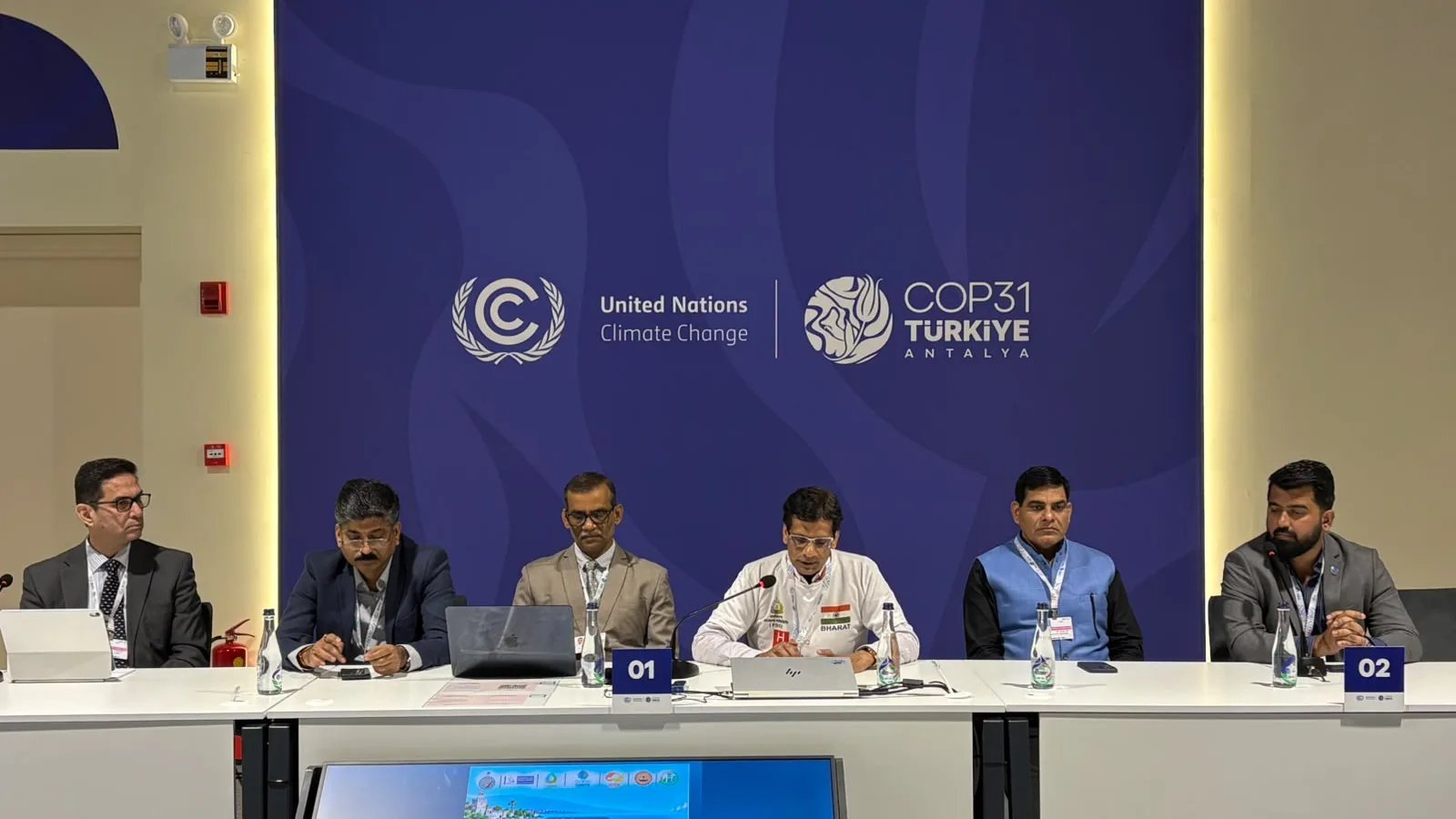
Mission LiFE is the embodiment of Citizen-Determined Contributions (CDCs) Team Harit Bharat presents the concept of Citizen-Determined Contributions at COP-31 Antalya (Türkiye), Addressing the climate change crisis requires the active participation of every citizen and community. Through Mission LiFE (Lifestyle for Environment), citizens across India are increasingly embracing environmentally responsible lifestyles. This, in essence, represents Citizen-Determined Contributions (CDCs)—an approach that every country should adopt alongside its Nationally Determined Contributions (NDCs). This proposal was presented by Team Harit Bharat of Paryavaran Sanrakshan Gatividhi (PSG) at an international dialogue held at the COP Expo Centre during the United Nations Climate Conference, COP-31, on the theme “HARIT Pathways to Climate PEACE: Just Transition through Citizen-Determined Contributions (CDCs).” The dialogue introduced an India-inspired, complementary approach to climate action, advocating Citizen-Determined Contributions (CDCs) alongside Nationally Determined Contributions (NDCs). It emphasized that, in addition to government commitments, every individual, family, community, educational institution and civil society organisation should voluntarily define its own locally relevant and measurable environmental commitments and take responsibility for implementing them. Moderating the dialogue, researcher Mahesh Koyana observed that the world must move towards environmental commitments that citizens themselves determine and translate into everyday action. NDCs Must Be Complemented by CDCs: Dr. Anil Mehta Opening the dialogue, Dr. Anil Mehta, associated with Vidya Bhawan Society, Udaipur, and Paryavaran Sanrakshan Gatividhi, stated that climate change is not merely an environmental, financial or technological challenge. It is also deeply connected with our lifestyles, patterns of production and habits of consumption. The actual success of national climate targets will depend on the active participation of millions of citizens and communities. Highlighting India's climate commitments and citizen participation, Dr. Mehta noted that India has made significant progress towards achieving its Nationally Determined Contribution (NDC) targets. In particular, the country achieved its target of deriving 50 per cent of its total installed electricity capacity from non-fossil fuel-based energy sources in June 2025, five years ahead of the scheduled deadline. India's *Mission LiFE – Lifestyle for Environment gives this progress the character of a people's movement. Through everyday actions such as conserving energy and water, reducing single-use plastics, segregating waste, promoting reuse, adopting sustainable transport, planting trees and making nature-friendly consumption choices, citizens are contributing to national climate objectives alongside the government. Dr. Mehta emphasised that these voluntary, locally driven, practical and measurable environmentally responsible lifestyle initiatives are, in essence, Citizen-Determined Contributions (CDCs) He observed that India's experience offers an important message to the world: climate commitments can become a genuine mass movement only when government-led NDCs are complemented by CDCs practised by citizens in their daily lives. This Indian experience deserves wider global adoption. Dr. Mehta urged the international community to promote CDCs alongside NDCs as a complementary, citizen-participatory framework for climate action. Explaining the concept, he said that individuals, families, communities, educational institutions and civil society organisations should voluntarily adopt measurable commitments according to their local environmental conditions and needs. These could include water and energy conservation, waste reduction, biodiversity protection, restoration of local ecosystems and responsible consumption. HARIT: Just Transition Must Also Transform Lifestyles Explaining HARIT—*Holistic Actions for Revitalizing Indigenous Traditions*—Dr. Mehta stated that a Just Transition should not be limited to shifting from fossil fuels to renewable energy. It must also bring about a fundamental transformation in our lifestyles and our relationship with nature. He said that this transition must involve moving: - From excessive resource consumption to responsible resource use; - From unnecessary consumption to mindful and prudent consumption; - From a throwaway culture to a Circular Bio-Economy; and - From exploiting nature to living in harmony with it. The HARIT approach emphasises integrating India's traditional water conservation systems, indigenous agricultural and food practices, biodiversity conservation and community participation with modern science, appropriate technologies and nature-based solutions. Referring to the Indian philosophical principle “Tena Tyaktena Bhunjitha” (enjoy through restraint), Dr. Mehta explained that restraint does not imply deprivation or scarcity. Rather, it means using natural resources responsibly while respecting the ecological limits of nature. He also presented the Indian philosophical concept of *Eternity (Shashwatata)*, explaining that it signifies living with restraint and harmony with all forms of life. Achieving this requires a transition from an anthropocentric worldview to an ecocentric one. Energy Transition Must Be Accompanied by Technological Innovation: Dr. Shiva Nagendra Dr. Shiva Nagendra S. M. of IIT Madras stated that addressing climate change requires technological innovation alongside lifestyle transformation. Significant work is already taking place in India in this direction. He stressed the need to develop academic platforms at the global level to facilitate the exchange of knowledge, experiences and ideas for addressing climate-related challenges. Commitments Must Be Translated into Action: Santosh Gupta Santosh Gupta of the Indian Social Responsibility Network (ISRN) highlighted India's cultural and community-based environmental traditions. He observed that Indian philosophy regards nature as Mother and “Vasudhaiva Kutumbakam” (the world is one family) as a guiding principle of life. He referred to traditional practices such as the conservation of sacred groves, rivers and trees, rainwater harvesting, Rajasthan's Johads and Baoris (traditional water-harvesting structures), community forests and organic farming. Highlighting the contribution of Amrita Devi Bishnoi, he described her legacy as an inspiring example of India's centuries-old commitment to environmental protection. Spiritual Transformation Is Equally Important: Cion Clark Cion Clark of the Spiritual Science Research Foundation (SSRF) stated that the climate crisis is connected not only with the environment but also with human behaviour, desires, consumption patterns and our attitude towards nature. Referring to the work of Maharshi Adhyatma Vishwavidyalay and the Spiritual Science Research Foundation, he explained that spiritual practices such as mantra chanting, personality-defect removal and the cultivation of sattvik qualities can facilitate inner transformation. He emphasised that building a more responsible and harmonious society begins with the transformation of individuals themselves. Youth Participation in Climate Action: Rajvardhan Joshi Representing the Ballerina Management Institute Trust (BMIT), Rajvardhan Joshi stated that young people must have a meaningful place in global decision-making processes and development initiatives. Youth participation should not remain confined to discussions and consultations. Young people must also be actively involved in policymaking, institutional leadership and grassroots implementation. He highlighted the important role being played by India's youth in environmental conservation. Taking Environmental Conservation from HARIT to Every Household: Sandeep Baliyan Sandeep Baliyan of Paryavaran Sanrakshan Gatividhi highlighted the role of Indian knowledge traditions, traditional ecological practices and community initiatives in environmental conservation. Referring to PSG's 3P approach and its HARIT Ghar Abhiyan, he emphasised the need to transform environmental awareness into practical actions at the household and community levels. He observed that traditional knowledge and local practices provide valuable guidance for responsible resource utilisation, ecological conservation and meaningful community participation. Climate Action Requires a Transformation in Human Consciousness and Lifestyles The dialogue concluded with a shared understanding that technology alone cannot address the climate crisis. What is equally necessary is a comprehensive transformation in society, culture, lifestyles and the human perspective towards nature. The HARIT approach envisions a world that is water-secure, resource self-reliant, ecologically harmonious and climate-resilient by integrating India's traditional wisdom with modern science, community-led action and effective policies. The dialogue called upon every citizen to become an active contributor to climate action and a responsible guardian and servant of Mother Earth The event also witnessed active participation by environmentally committed young participants, including Arham Bardiya, Samudra Nashkar, Aastha Bafna, Vivek Kumar and Ileana.
COP-31,Antalya (Türkiye) : Let the World Embrace Mission LiFE
Citizen-Determined Contributions should receive recognition alongside Nationally Determined Contributions (NDCs)