
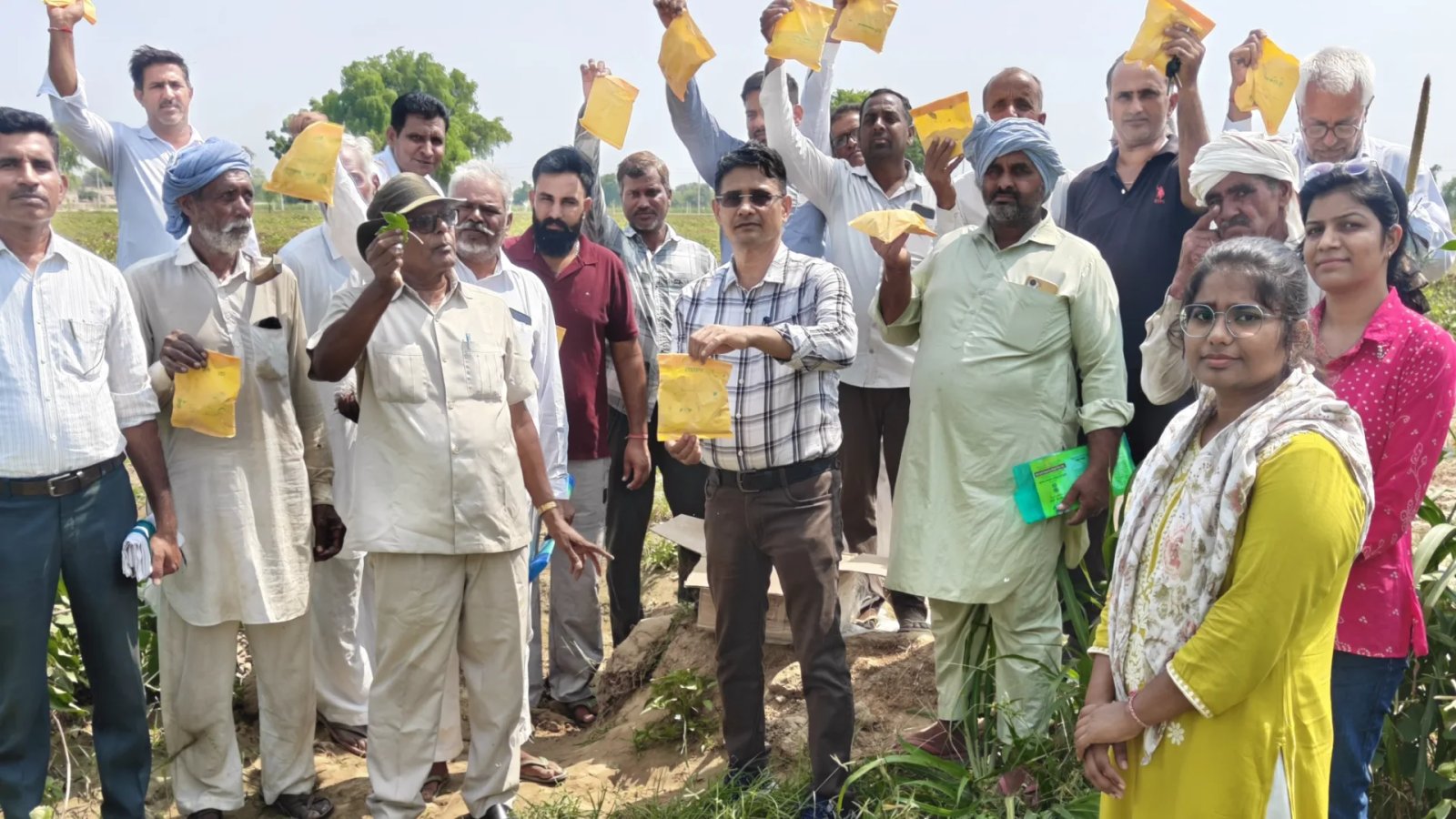
Sri Ganganagar: A two-day Human Resource Development (HRD) training programme for farmers was organised by the Locust-cum-Integrated Pest Management Centre, Sri Ganganagar, in Manniwali village, Sadulshahar block, on September 15 and 16, 2026. The programme provided farmers with scientific information on crop protection, pest and disease management, and environment-friendly agricultural practices.
The programme was inaugurated by Dr. R. K. Sharma, Deputy Director (Weed Science), who highlighted the importance of Integrated Pest Management (IPM). He encouraged farmers to adopt biological, mechanical and other scientific methods along with chemical measures for effective crop protection. He also stressed that regular crop monitoring is a fundamental requirement for successful pest management.
Prakash Chandra, Assistant Director, briefed farmers about the problem of pink bollworm in cotton, its identification and effective management measures. He urged farmers to monitor their crops regularly and take timely action using recommended techniques to control infestations.
Jitendra Meena, Assistant Plant Protection Officer (Entomology), provided information on the identification, monitoring and management of major harmful insect pests affecting different crops.
Karina Baiflawat, Assistant Plant Protection Officer, explained the major diseases affecting kharif crops, their early symptoms, and scientific methods for prevention and management.
R. K. Choudhary, Scientific Assistant, explained the usefulness of the National Pest Surveillance System. He also demonstrated simple methods of testing soil pH and explained the importance of maintaining appropriate pH levels for healthy crop production.
Varsha, Scientific Assistant, highlighted the use and importance of Trichoderma in managing soil-borne diseases. She also explained the role of beneficial insects in agriculture and the need for their conservation.
The programme was attended by Riya Chawla, Assistant Agriculture Officer Indraj, Agriculture Supervisors Kuldeep and Praveen Kumar, representing the state government, along with representatives of the Ambuja Foundation.
During the training, emphasis was placed on providing farmers with practical and scientific knowledge, particularly on the importance of biological methods in crop protection. At the conclusion of the programme, each participating farmer was provided with a packet of Trichoderma for use in managing soil-borne diseases in their fields.
The two-day training covered key aspects of Integrated Pest Management, pink bollworm management, diseases of kharif crops, pest surveillance, the National Pest Surveillance System, soil pH management, Trichoderma application and conservation of beneficial insects.
Farmers described the training as useful for strengthening crop protection practices and improving overall farm management.