
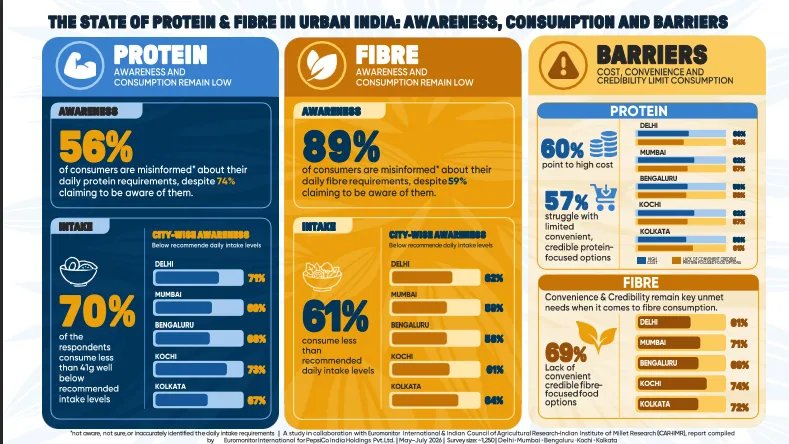
Indian consumers are increasingly paying attention to nutrition, but awareness does not always translate into dietary choices. A new study by PepsiCo India, in association with Euromonitor International and the Indian Institute of Millet Research (IIMR) studies how consumers think about protein, fibre and oats, and what can make better nutrition more practical and accessible.
Titled ‘The State
of Protein & Fibre in Urban India’, the study surveyed 1,250
respondents aged 18–50 years across Delhi, Mumbai, Bengaluru, Kolkata and Kochi,
examining protein and fibre awareness and intake, lifestyle and breakfast
habits, factors influencing dietary choices, perceptions of oats and overall
health orientation.
Some key findings
from the study are:
·
Awareness doesn’t
always mean understanding: While 74% of
consumers claim to be aware of their daily protein requirements, 56% are
misinformed - either unaware, unsure or unable to accurately identify their
daily requirement.
·
Protein is falling
short on the plate: 70% of
respondents consume less than 41g of protein, well below recommended intake
levels, with the intake gap seen across all five cities surveyed.
·
The knowledge gap is
even wider for fibre: While 59% claim to
know their daily fibre requirement, 89% are misinformed, with only 11%
accurately identifying the recommended intake.
·
Fibre intake falls
short across cities and generations: 61% consume less than recommended daily fibre intake levels,
with the gap rising to 65% among Gen X, compared with 58% among Gen Z and
Millennials.
·
Consumers want
protein to fit more naturally into everyday eating: Around 9 in 10 consumers across generations wish adding protein
to their diet felt easier and more natural, while 89% want protein in more
familiar, everyday formats.
·
Cost and convenience
are holding protein consumption back: 60% cite high cost, while 57% point to a lack of convenient,
credible protein-focused food options as key barriers.
·
For fibre, access to
the right options is an even bigger barrier: 69% say there is a lack of convenient, credible fibre-focused food
options, rising to 74% in Kochi, 72% in Kolkata and 71% in Mumbai.
The study was
unveiled at an event supported by the Confederation of Indian Industry (CII), bringing together
voices from nutrition, public health and industry. Anchored in the study
findings, the discussion explored the gap between nutrition awareness and
consumption, and the need to make better nutrition more accessible, familiar
and easier to consume every day.
Speaking on the
launch of the study, Dr. Ankita Marwaha, Director R&D LifeScience &
India R&D Site Lead, PepsiCo India, said: “As nutrition becomes increasingly central to how consumers think
about their health and wellbeing, awareness alone is not enough. What matters
is helping people translate credible nutrition knowledge into practical
everyday choices. At PepsiCo India, staying close to consumers and
understanding how their needs and behaviours are evolving is important to us.
We also continue to engage with the research and academic community to deepen
our understanding of nutrition and explore how we can offer better options
while enabling consumers to make more informed decisions. This study is part of
that journey, highlighting important gaps between awareness, understanding and
action around protein and fibre, and giving us deeper insight into the
realities that shape everyday food choices.”
With over 145 years
of global heritage and a presence in India since 2006, Quaker is an important
part of PepsiCo Foods’ portfolio. As the world’s No.1 oats brand¹,
Quaker is building on its expertise in oats and nutrition to play a broader
role in nutrition, with an increasing focus on protein and fibre.
Additionally, the
study finds a strong desire among Gen Z to make protein easier to incorporate
into everyday diets: 89% wish adding protein to their diet felt easier and
more natural, while 90% want protein to be available in more familiar, everyday
formats.
Commenting on the
findings, Dilip Radhakrishna, Senior Consultant at Euromonitor International,
said,
“The study highlights a gap between consumers’ interest
in protein and fibre and their understanding of daily nutritional needs. Many
respondents say they actively look for these nutrients in their diets, yet
claimed awareness of daily requirements does not consistently translate into
accurate knowledge, particularly for fibre. These knowledge gaps are evident
across the five cities and age groups, pointing to an opportunity for nutrition
communication to go beyond awareness and help consumers understand how much
they need and how everyday food choices can help them meet those needs.”
The findings point to
a broader need to make nutrition easier to translate into everyday choices.
Across generations, consumers expressed a strong preference for protein that
fits more naturally into their diets, while convenience and credibility also emerged
as significant barriers to fibre consumption.
Through the study,
PepsiCo India aims to deepen understanding of evolving consumer needs and
contribute to a broader conversation around how better nutrition can become
more practical, accessible and relevant to everyday lifestyles.