
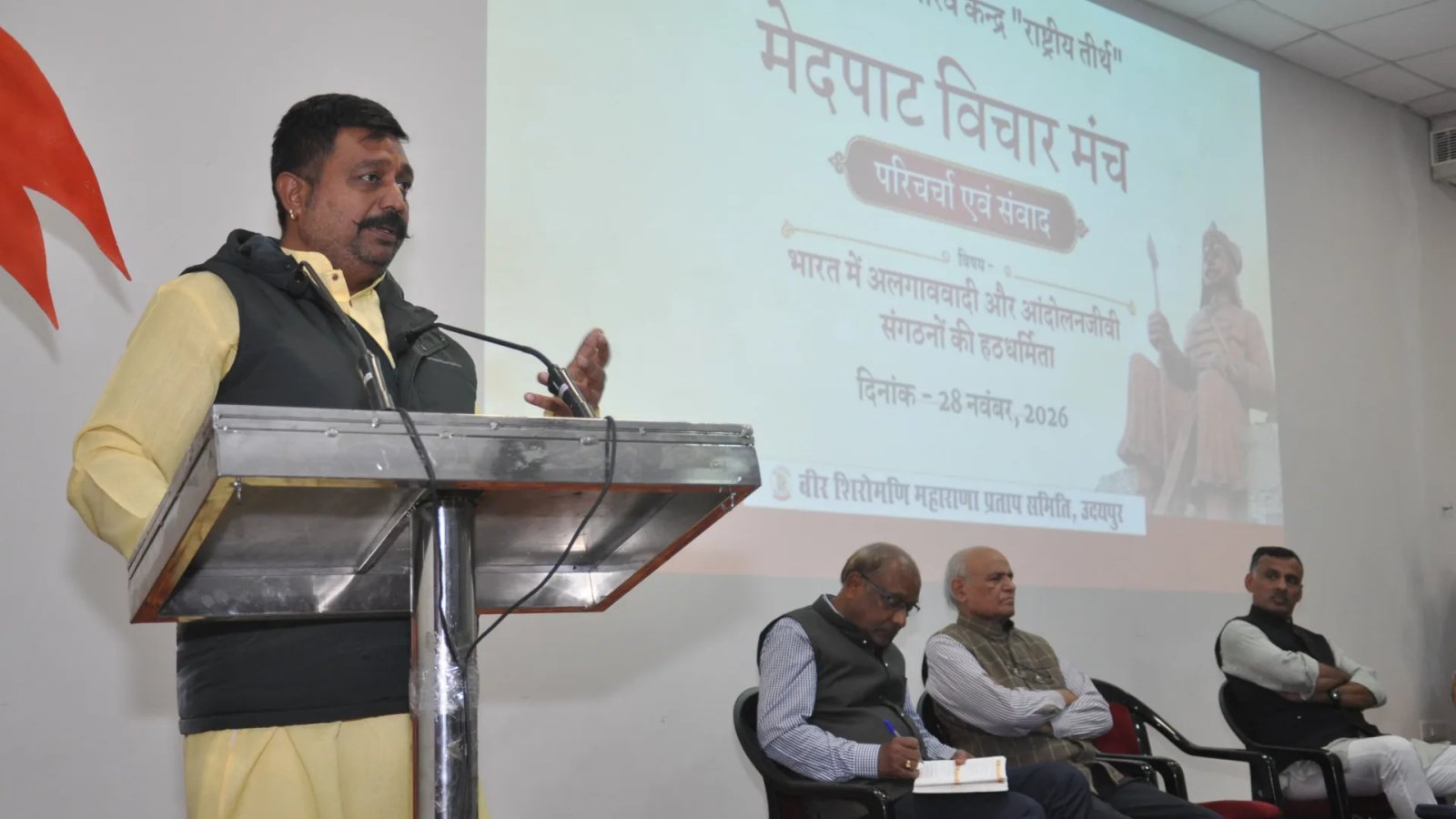
Udaipur,Ordinary citizens must remain aware and actively support the nation, while positive and constructive forces in society need to be awakened to counter anti-national narratives. This was stated by Prof. Bhagwati Prakash Sharma, President of the Veer Shiromani Maharana Pratap Samiti, Udaipur, while delivering the presidential address at a seminar organised by the Medpat Vichar Manch.
The seminar focused on the theme, “The Obstinacy of Separatist and Agitation-Driven Organisations in India”. Academicians, former military officers and social thinkers shared their perspectives on the subject. The introductory remarks were delivered by Prof. Subhash Bhargava, Convenor of the forum.
Prof. Sharma analysed nationalism and disruptive forces through global examples, referring to the disintegration of the Soviet Union into 15 independent republics and Yugoslavia into seven separate countries. He spoke about the emergence of smaller movements in Latin America and alleged that substantial financial support was provided by the United States for missionary activities. He also referred to movements that emerged in response to the spread of nationalism and the demand for a Christian state in Nagaland. Emphasising the need to counter what he described as misleading narratives, Prof. Sharma said there was a need to challenge claims that tribal communities and Scheduled Castes do not belong to the Hindu social and cultural fold.
Speaking as a guest speaker, Anurag Saxena, Director of Pratap Gaurav Kendra, presented a historical perspective and noted that India had witnessed several constructive movements against social evils, during the Bhakti movement and against the Emergency. However, he raised questions about several movements in recent years, including the farmers' protests, the JNU movement, India Against Corruption, Shaheen Bagh and protests related to the NEET examination. He also discussed the roles played by prominent individuals such as Aruna Roy, Arvind Kejriwal, Yogendra Yadav, Medha Patkar, Prakash Raj, Kunal Kamra and Sonam Wangchuk in these movements.
Dr. Baludan Barhath, Associate Professor in the Department of Political Science at Mohanlal Sukhadia University, said separatist forces in the country had gained ground due to the failures of successive governments and political appeasement. He held the political leadership of the time responsible for several developments, including the incomplete integration of the erstwhile Kashmir princely state, the excessive importance given to Sheikh Abdullah, the encouragement allegedly extended to Jarnail Singh Bhindranwale to weaken the Akali Dal in Punjab, and the rise of separatist and insurgent movements in Tamil Nadu, Assam, the Northeast and Naxal-affected regions.
Referring to an editorial published by British newspaper The Guardian on May 18, 2014, in connection with Narendra Modi's swearing-in as Prime Minister, he highlighted its reference to the “final end of British rule”. He said India was regarded as a 'soft state' before 2014, while subsequent action by the Central Government against anti-national and violent activities had changed the situation. He also referred to activities of pro-Khalistan elements outside the country, the emergence of the 'Urban Naxal' phenomenon and the tendency of separatist groups to project themselves as protest movements.
Brigadier Harshvardhan Singh, another speaker, said separatism had been encouraged by the weak political will of successive governments and their failure to take timely cognisance of activities in neighbouring countries. He also highlighted the spread of misleading narratives suggesting that Kashmir was not an integral part of India. He called for comprehensive monitoring of madrasa schools and the provision of strong educational alternatives.
Referring to the northeastern states, he described Arunachal Pradesh as an exception, noting that it had no history of violent movements. He attributed this, in part, to the influence of institutions such as the Ramakrishna Mission, while expressing concerns about the influence of Christian missionary activities in other northeastern states. He also identified demographic changes in Rajasthan's border districts and religious conversions in the Vagad region as major challenges, stressing the need to strengthen national consciousness and promote awareness of India's cultural heritage.
Prof. Anil Kothari, Principal of Gurunanak Girls College, questioned who was indirectly encouraging movements within the executive and judiciary, and stressed the need for vigilance. He said misleading narratives had been created around movements such as the Special Intensive Revision (SIR) exercise. He added that failure to take strict action against those violating the law during protests could encourage anarchic elements.
Chandresh Bapna, State Minister of the Vanvasi Kalyan Parishad, and Prof. Umashankar Sharma, former Vice-Chancellor of Maharana Pratap University of Agriculture and Technology (MPUAT), spoke about the work undertaken by the Vanvasi Kalyan Parishad and Dharma Jagran initiatives in tribal areas, claiming that these efforts had helped curb religious conversions.
Vishwanath Joshi, former Dean of Rajasthan College of Agriculture, identified the perceived conflict between Islamic and Hindu cultures as a major factor behind these struggles. Meanwhile, Prof. Abhay Mehta, retired faculty member of MPUAT, recalled the positive contributions of mass movements such as the Jayaprakash Movement and the Chipko Movement.