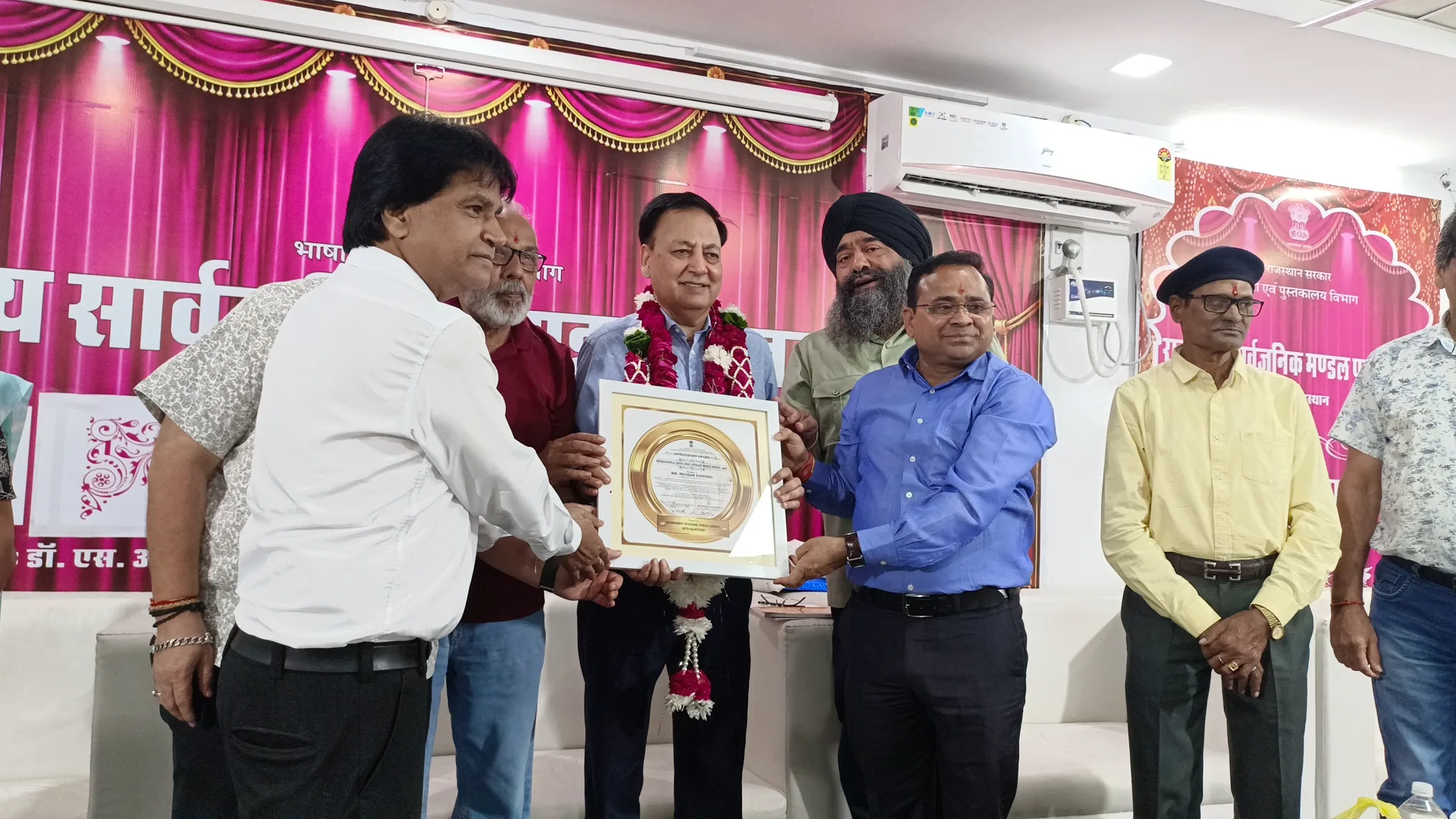
KOTA: In an evening where literature transcended geographical boundaries and cultural traditions converged in a spirit of warmth and mutual respect, the Government Divisional Public Library, Kota, hosted a distinguished literary felicitation ceremony honouring renowned Dubai-based mushaira and poetry-convention organiser and digital content creator Rehaan Siddiqui. Recognising his contribution to promoting Hindi–Urdu literature and bringing poets and literary voices to wider audiences through digital platforms, he was conferred the International Hindi–Urdu Literary Bridge Award–2026. The ceremony also honoured poet, thinker and Additional District and Sessions Judge Dharmaraj Bharat for his literary contributions. The programme was organised through the initiative of Dr Deepak Kumar Shrivastava, Divisional Librarian and Nodal Officer, Public Libraries, Kota Region, reaffirming the library’s evolving role as a vibrant centre of literary engagement, cultural exchange and intellectual dialogue. In his welcome address, Dr Shrivastava highlighted the importance of creating inclusive platforms where writers, poets, critics and readers can connect beyond institutional and ideological boundaries. Building a Bridge Between Literature and the Digital World Addressing the gathering, Rehaan Siddiqui reflected on a persistent challenge in the literary world: exceptional poetry is often celebrated during mushairas and literary gatherings but fails to reach a wider audience once the event concludes. Together with his wife and creative partner, Shiaza Siddiqui, he has worked to present literary performances through engaging digital content, helping poets gain greater visibility and enabling their words to travel beyond traditional audiences. Emphasising the importance of capturing viewers’ attention in the opening seconds of a digital video, he explained how thoughtful presentation and compelling storytelling can introduce poetry to new generations. He also recited several couplets, interacted warmly with the literary fraternity and expressed heartfelt gratitude for the affection he received in Kota, remarking that the atmosphere made him feel as though he were among his own literary family in Dubai. An Evening Enriched by Poetry, Criticism and Cultural Camaraderie The gathering brought together an eminent assembly of writers, poets, critics and cultural contributors. Distinguished participants included Dr Atul Chaturvedi, senior satirist; Mahendra Neh, senior litterateur; Jitendra Nirmohi, noted literary figure; Mukut Maniraj, acclaimed Rajasthani lyricist; Vijay Joshi, senior critic; Tarumeet Singh Bedi, writer and poet; Prem Shastri, lyricist; Nishamuni Gaur, senior poet; Dr Manisha Sharma, Head of the Hindi Department at Janki Devi Bajaj Government Girls College, Kota; and Dr Jagdish Nirala, Rajasthani lyricist. Poetic recitations, literary reflections and personal recollections lent the evening its distinctive character. Mukut Maniraj captivated the audience with his evocative romantic poetry, while Nishamuni Gaur and Prem Shastri offered engaging poetic expressions rooted in memory, tradition and popular culture. Jitendra Nirmohi shared reflections on the legendary Urdu poet Kaifi Bhopali and the free-spirited world of poets and shayars. Presiding over the ceremony, Dharmaraj Bharat presented an insightful perspective on the relationship between Kota’s history and its literary heritage. His intellectual engagement, humility and commitment to literature were warmly acknowledged. Having been transferred from Kota to Bhawanimandi, his felicitation also carried a note of appreciation for his contribution to the city’s literary community. Tarumeet Singh Bedi further enriched the occasion by presenting his poetry collection, Tasavvur. A Public Library as a Living Cultural Institution The ceremony reflected the distinctive literary culture of Kota, where writers representing diverse intellectual traditions continue to sustain relationships through dialogue, mutual respect and participation in one another’s initiatives. The gathering reinforced the idea that the true value of a literary event lies not merely in its scale or ceremony, but in the quality of its ideas, the intimacy of its exchanges and the lasting connections it creates. Under the initiative of Dr Deepak Kumar Shrivastava, the Government Divisional Public Library, Kota, has increasingly served as a shared platform for literary and cultural activities, extending its role beyond conventional reading services to encourage creative expression and community engagement. The proceedings were conducted with elegance by Neeta Dangi, whose confident voice and engaging presentation complemented the spirit of the occasion. The event was attended by numerous writers, poets, journalists, social contributors and library personnel, including Hemraj “Hem”, Ramkaran Prabhati, Dinesh Singh Chauhan, Suresh Vaishnav, Badri Lal Divya, Haleem Aina, Suresh Pandit, Indra Kumar Jain and other members of Kota’s literary community. Literature That Connects People and Generations The evening concluded with a shared appreciation of the enduring power of literature to connect languages, communities and generations. The recognition of Rehaan Siddiqui celebrated efforts to carry the richness of Hindi–Urdu poetry into the digital age, while the felicitation of Dharmaraj Bharat acknowledged the continuing contribution of literary-minded individuals to Kota’s cultural life. More than a felicitation ceremony, the gathering stood as a testament to the enduring bond between literature and human relationships—demonstrating how a public library can become a meeting ground for ideas, artistic expression and cultural harmony. The message of the evening was clear: when literature finds new platforms and people find common ground, words become bridges—and those bridges bring cultures closer.
Beyond Borders, Beyond Languages: Kota Celebrates the Universal Language of Literature
From Dubai to Kota: A Literary Bridge of Hindi–Urdu Heritage, Cultural Harmony and Digital Innovation