
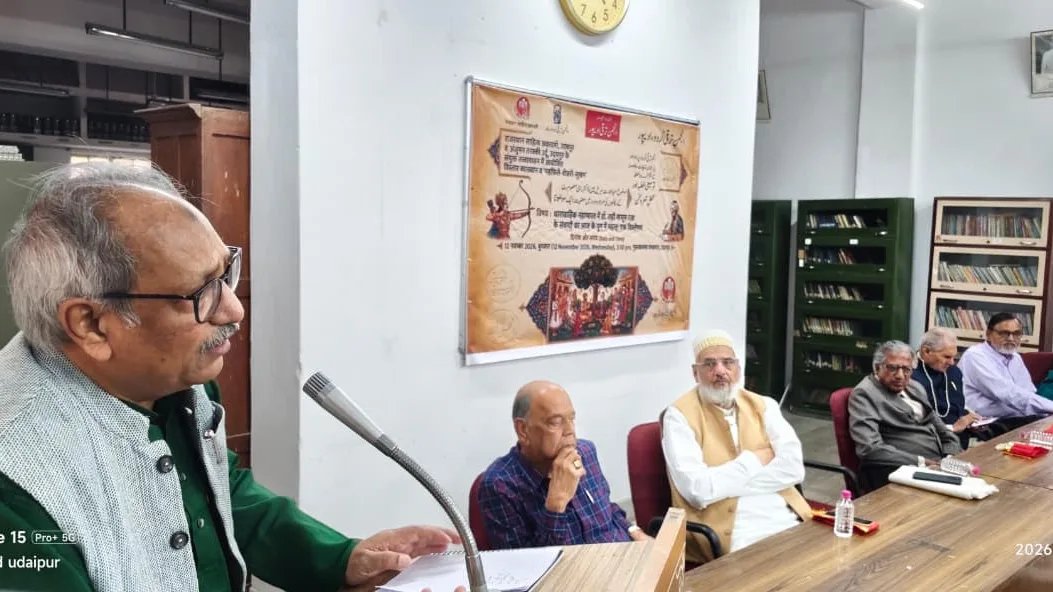
- Dr. H.S, Chandalia Udaipur,Rajasthan Sahitya Academy and Anjuman Taraqqi Urdu, Udaipur jointly organized an extension Lecture and a Mushayara on 12th of November ,2026 in the Library Hall of Rajasthan Sahitya Academy, Udaipur to Commemorate the Centenary Year of Dr. Rahi Masoom Raza, renowned poet, novelist and screenplay and dialogue writer of the Television serial Mahabharat. The Extension Lecture was delivered by Prof. Safdar Imam Kadri of Patna. Prof. Hemendra Singh Chandalia, poet, journalist and former Dean, Faculty of Social Sciences and Humanities, Janardan Rai Nagar Rajasthan Vidyapeeth was the guest of honour. The programme was chaired by Poet and former member of Sanchalika of Rajasthan Sahitya Academy Kishan Dadhich. Prof. Sarvattunisa Khan, organizing secretary of the programme presented the welcome address. The programme was convened graciously by Dr. Siddhika Hussain while the vote of thanks was offered by the secretary of Anjuman Taraqqi Urdu, Rajasthan Prof. Prem Bhandari. Opening up the deliberation Prof. Kadri expressed his happiness in coming over to Udaipur as he saw the town as not only beautiful but also open to liberal ideas and widening of the horizon of thought. Talking on the theme “ The Relevance of the Dialogues of the Mahabharat Serial written by Dr. Rahi Masoom Raza in the Present Times : An Analysis” Prof. Safdar Imam Kadri said that the beauty of Rahi Masoom Raza’s dialogues in the serial Mahabharat lies in his ability to make an ancient text relevant to the present times so that people could directly relate to the serial. He stated that Dr. Rahi started his literary career with Urdu, chose Hindi for his fiction and film writing and mastered a sanskritized Version of Hindi to make his dialogues appear real in the context of a classical theme. He said that it would not be correct to say that Mahabharat is a religious text alone. It is a political and social text. This was proved by the resounding success of the serial in India and abroad. He said that it is not possible to compartmentalize the works of a writer. Dr. Rahi Masoom Raza is both a Hindi writer as well as an Urdu writer. He cited several such examples. Mirza Ghalib is as great a poet of Urdu as of Persian. The work of Jayasi Padmawat and Tani Ketaki Ki kahani by Insha Alla Khan Insha were both initially written in Persian. He narrated his memoir of Habib Tanveer who is known for his Chhattisgarhi style of drama but when he looked through his diary he found that ninety nine percent notings were in Urdu. He said that as a writer decides to write in another language he has to undergo a process of translation, transcription and transcreation as per the need of the text. Prof. Kadri narrated several anecdotes of the making of the serial Mahabharat. He said that Dr. Rahi Masoom Raza had worked with B.R. Chopra earlier for some documentaries and films. So he was convinced that Dr. Rahi will be the suitable person to write the screenplay and dialogues for the serial. It was during the Rajeev Gandhi government that the idea of making a serial on Ramayan and Mahabharat to showcase Indian Culture. The then Prime Minister Rajiv Gandhi was himself interested in the project. Ramanand Sagar gor approval for the Ramayan first so the project of the Mahabharat had to wait for two years. When B.R.Chopra approached Dr. Rahi Masoom Raza to write the screenplay of Mahabharat he declined due to his previous commitments. But somehow, the media got the news. It was published. The fundamentalist forces of both the religions opposed his appointment as screenplay writer. Hindu fundamentalists wrote to B.R.Chopra that why he chose a Muslim to write the serial on Mahabharat, were all Hindu writers dead?
Contrarily the Muslim fundamentalists asked why Dr. Rahi Masoom Raza agreed to write for a serial on a Hindu text?
A number of letters were written to B.R.Chopra. He sent them to Dr. Rahi Masoom Raza. On seeing those letters he swore that now only he would write the screenplay and dialogues of the serial. He called himself the son of the Ganges. Guest of Honour Prof. Hemendra Chandalia , poet, journalist and formerly Dean, Faculty of Social Sciences and Humanities, Janardan Rai Nagar Rajasthan Vidyapeeth, Udaipur said that Dr. Rahi Masoom Raza was a firm believer in the composite culture of India and represented the multilingual, multicultural ethos of the country in his writings. He remembered Prof. Moonis Raza also, elder brother of Dr. Rahi Masoom Raza who was the Vice Chancellor of Delhi University and was also among the founders of Jawahar lal Nehru University , New Delhi. He said that Dr. Rahi Masoom Raza,like his contemporaries Bhishma Sahani, Ali Sardar Zafri, Khwaja Ahmad Abbas , Kamleshwar and several others represented the common people in his writings. The serial Mahabharat was also written in a language which was both representative of the ancient epic as well as modern in its sensibility. Twentieth century citizens could identify with the serial. He described the serial as a retelling of the ancient epic. Referring to A.K. Ramanujan’s celebrated essay “ Three Hundred Ramayan’s” he said that Dr. Rahi Masoom Raza studied one hundred retellings of Mahabharat before writing the screenplay. He mentioned the tribal retellings of Mahabharat like “ Bhilon Ka Bharat” . He said that the existence of multiple versions of a text in a society is a sign of its good health. He talked of the end of Mahabharat where in Stree Sarg it is mentioned that one Arab sixty six Crores and twenty thousand combatants died in the eighteen days war. He said that this number was more than five times the number of the two world wars together. He described Mahabharat as an anti-war text and implored people to spare the glorification of wars. He proposed that the August number of the magazine of Sahitya Academy Madhumati should be brought out as a special issue on Dr. Rahi Masoom Raza to mark his centenary. Presiding over the programme poet and lyricist Kishan Dhadhich underlined the ability of Dr. Rahi Masoom Raza to assimilate Indian culture and represent it through the dialogues of the serial Mahabharat in flawless Hindi. He remarked that Dr. Rahi was truly a son of the soil. After the extension lecture a Mushayara was organized in which Dr. Madhu Bhatt, Ms. Shakuntala Saruparia, Dr. Shahid Sheikh, Dr.Prem Bhandari, Kishan Dadheech, Dr. Sarvattunisa Khan, Dr. Siddhika Hussain, Abid Hussain Adeeb and others presented their poetic creations.