
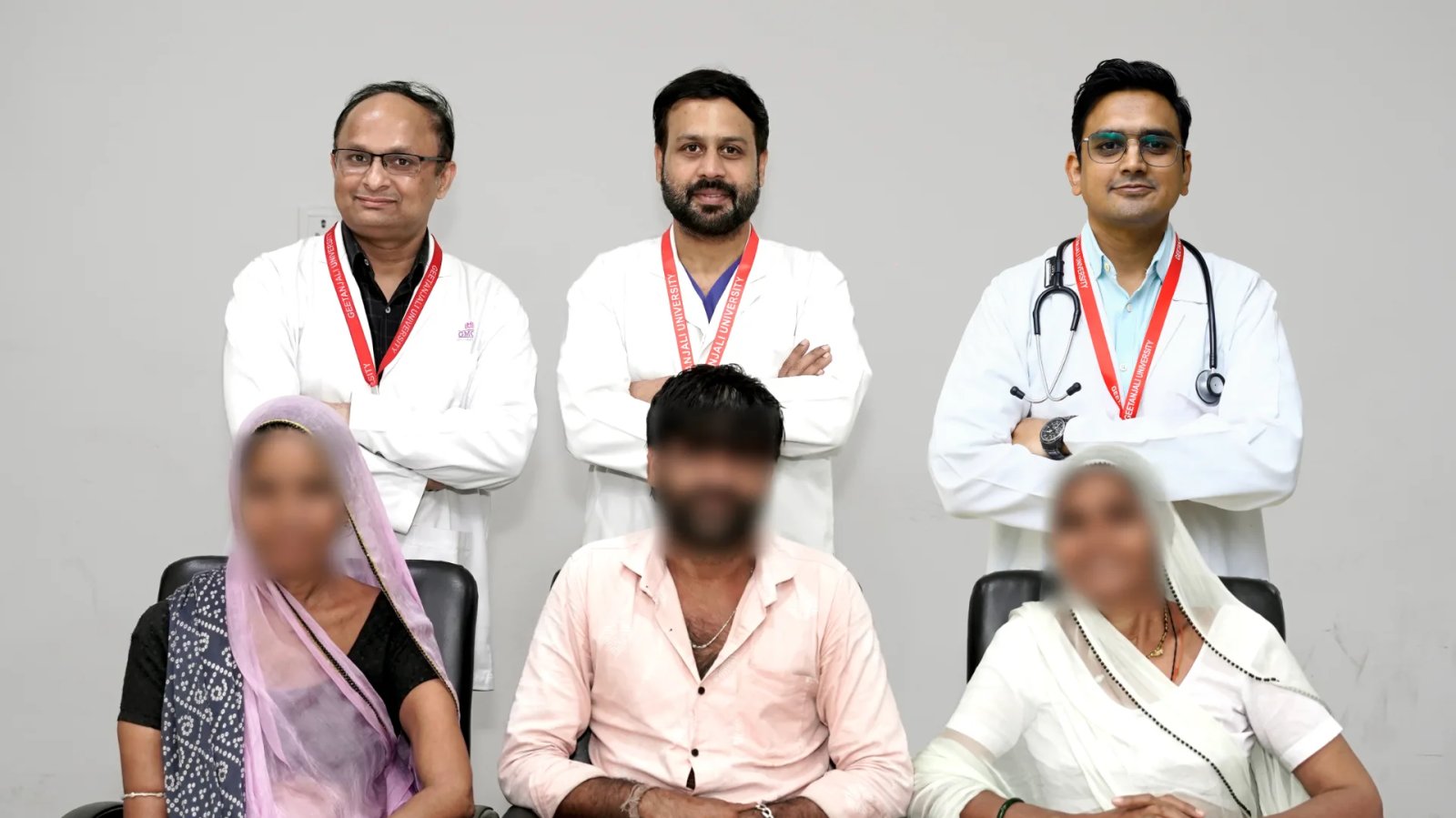
Complex adrenal gland and medullary thyroid cancer surgeries successfully performed by a multidisciplinary specialist team
Udaipur: A rare and complex case involving three siblings from Rajsamand, diagnosed at different stages with genetically linked cancers, has been successfully treated at Geetanjali Cancer Centre, Udaipur. The challenging cases involved tumours of the adrenal glands and medullary thyroid cancer, requiring coordinated care by a multidisciplinary team of cancer surgeons, an endocrinologist and an anaesthesia specialist.
The treatment team included Dr Ashish Jakhetiya, Head of the Department and Cancer Surgeon; Dr Ajay Yadav, Cancer Surgeon; Dr Rahul Sahlot, Endocrinologist; and Dr Naveen Patidar, Anaesthesia Specialist.
The first case: Bilateral adrenal tumours followed by thyroid cancer
The case began when one of the sisters was diagnosed with tumours measuring more than 10 cm in both adrenal glands. The condition had resulted in severely uncontrolled blood pressure and was also affecting her heart, making surgery particularly challenging and high-risk.
After detailed evaluation at Geetanjali Cancer Centre, both adrenal tumours were surgically removed.
Adrenal tumour surgery can be particularly demanding because manipulation of the tumour may cause sudden and extreme fluctuations in blood pressure. To reduce the risk, the patient underwent approximately 10 days of endocrine optimisation according to the prescribed protocol under the supervision of Dr Rahul Sahlot.
During surgery, the patient's blood pressure rose as high as 260/150 mmHg, while after removal of the tumour it dropped to around 60 mmHg, highlighting the complexity of the procedure. The surgical and anaesthesia teams worked in close coordination to safely manage these fluctuations.
During follow-up after the first surgery, thyroid cancer was detected. Once her condition stabilised, a second surgery was performed approximately two months later.
More than three years after treatment, the patient is living a normal life and has not required chemotherapy or radiation therapy.
A genetic link emerges
Considering the possibility of a hereditary condition, genetic testing was advised for the family. However, the investigation could not be performed at the time due to financial constraints.
Approximately two years later, the patient's brother developed a swelling in his neck. Detailed investigations at Geetanjali Cancer Centre confirmed medullary thyroid cancer. He underwent surgery and, two years later, continues to lead a normal life.
The third sibling faces a similar challenge
The family's third sibling, the eldest sister, sought treatment approximately three months ago after developing a large lump measuring around 8–9 cm in the neck.
Given the history of cancer in two siblings, doctors suspected a possible hereditary cancer syndrome and conducted a comprehensive evaluation.
Investigations revealed tumours in both adrenal glands, along with spread of the thyroid-related disease in the neck to the lymph nodes.
The treatment was carried out in stages. Both adrenal tumours were first surgically removed, followed by surgical treatment of the neck mass and associated disease.
Family screening and genetic counselling can be crucial
According to the specialists, rare hereditary cancers require careful evaluation not only of the affected individual but also of close family members. Once a genetically linked cancer is identified in one member of a family, timely screening and genetic counselling can play an important role in detecting the disease in other relatives at an earlier stage.
The treatment of all three siblings required close coordination between cancer surgery, endocrine management and anaesthesia teams.
Following thyroid surgery, patients require thyroid hormone replacement in the prescribed dosage along with regular endocrine follow-up.
One treatment journey led the family back to the same centre
The successful treatment of the three siblings at Geetanjali Cancer Centre also reflects the family's continued trust in the specialist team. After one family member underwent treatment, the other siblings subsequently chose the same centre for their evaluation and treatment.
The case highlights the importance of early recognition of hereditary cancer patterns, family screening, genetic counselling and multidisciplinary cancer care in managing complex and rare malignancies.